
|
You entered: light
 APOD: 2026 March 6 Б The Astrosphere of HD 61005
6.03.2026
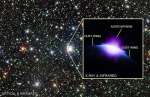
Do young stars blow bubbles? The larger view shows a stellar field observed with the Cerro Tololo Inter-American Observatory in Chile, and the inset highlights HD 61005, a star like our Sun, only 120 light-years away.
 Dust Pillars of the Carina Nebula
30.04.2007
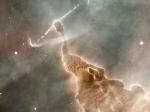
Inside the head of this interstellar monster is a star that is slowly destroying it. The monster, actually an inanimate pillar of gas and dust, measures over a light year in length. The star, not itself visible through the opaque dust, is bursting out partly by ejecting energetic beams of particles.
 Cygnus Trio
7.11.2008
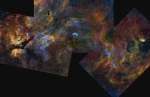
In this colorful mosaic, filaments of gas and dust span some 9 degrees across central Cygnus, a nebula rich constellation along the northern Milky Way. A trio of nebulae with popular names highlights the beautiful skyscape - the Butterfly, the Crescent, and the Tulip.
 A 2017 U1: An Interstellar Visitor
3.11.2017
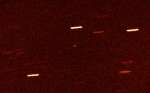
Traveling at high velocity along an extreme hyperbolic orbit and making a hairpin turn as it swung past the Sun, the now designated A/2017 U1 is the first known small body from interstellar space.
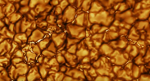 Solar Granules at Record High Resolution
3.02.2020
Why does the Sun's surface keep changing? The help find out, the US National Science Foundation (NSF) has built the Daniel K. Inouye Solar Telescope in Hawaii, USA. The Inouye telescope...
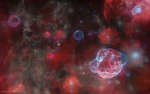 The Ghosts of Five Supernovas
24.09.2026
The ghosts of five supernovas haunt this extraordinary image. It was acquired at Oukaцmeden Observatory in Morocco with approximately 200 hours of observations and shows a large patch of the sky, equivalent to the area of one thousand full moons tiled together, in the constellation of Auriga (the charioteer).
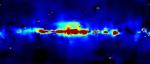 The Milky Way's Gamma-Ray Halo
5.11.1997
Our Milky Way galaxy appears to be surrounded by a halo of gamma rays. Gamma rays are the most energetic form of electromagnetic radiation, with more than a hundred thousand times the energy of visible light, but known gamma-ray sources don't account for the diffuse distribution of this high-energy glow.
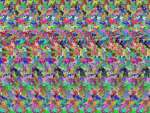 The Holographic Principle
16.12.2007
Is this picture worth a thousand words? According to the Holographic Principle, the most information you can get from this image is about 3 x 10 65 bits for a normal sized computer monitor.
 A Total Lunar Eclipse Over Tajikistan
11.07.2011
If the full Moon suddenly faded, what would you see? The answer during the total lunar eclipse last month was recorded in a dramatic time lapse video from Tajikistan. During a total lunar eclipse, the Earth moves between the Moon and the Sun, causing the moon to fade dramatically.
 South of Orion
27.01.2022
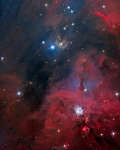
South of the large star-forming region known as the Orion Nebula, lies bright blue reflection nebula NGC 1999. At the edge of the Orion molecular cloud complex some 1,500 light-years distant, NGC 1999's illumination is provided by the embedded variable star V380 Orionis.
|
January February March April May June July August September October |
|||||||||||||||||||||||||||||||||||||||||||||||||