
|
You entered: light
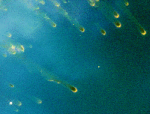 Cometary Knots in the Helix Nebula
16.04.1996
Four hundred fifty light-years from Earth, the wind from a dying, sun-like star produced a planetary nebula popularly known as the Helix. While exploring the Helix's gaseous envelope with the Hubble Space Telescope (HST), astronomers discovered indications of 1,000s of striking "cometary knots" like those shown above.
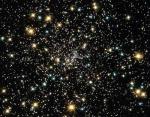 Blue Stragglers in NGC 6397
8.08.2003
In our neck of the Galaxy stars are too far apart to be in danger of colliding, but in the dense cores of globular star clusters star collisions may be relatively common. In fact...
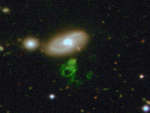 What is Hanny's Voorwerp?
25.06.2008
What is that green thing? A volunteer sky enthusiast surfing through online Galaxy Zoo images has discovered something really strange. The mystery object is unusually green, not of any clear galaxy type, and situated below relatively normal looking spiral galaxy IC 2497.
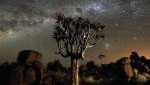 Namibian Nights
4.02.2013
Namibia has some of the darkest nights visible from any continent. It is therefore home to some of the more spectacular skyscapes, a few of which have been captured in the above time-lapse video.
 A Volcanic Great Conjunction
20.12.2020
Where can I see the Great Conjunction? Near where the Sun just set. Directionally, this close passing of Jupiter and Saturn will be toward the southwest. Since the planetary pair...
 APOD: 2024 October 20 Б Dark Matter in a Simulated Universe
20.10.2024
Is our universe haunted? It might look that way on this dark matter map. The gravity of unseen dark matter is the leading explanation for why galaxies rotate so fast, why galaxies orbit clusters...
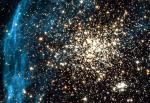 NGC 1850: Not Found in the Milky Way
12.07.2001
A mere 168,000 light-years distant, this large, lovely cluster of stars, NGC 1850, is located near the outskirts of the central bar structure in our neighboring galaxy, the Large Magellanic Cloud. A first...
 The Holographic Principle
30.04.2002
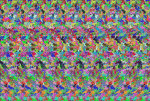
Is this image worth a thousand words? According to the Holographic Principle, the most amount of information you can get from this image is about 3 x 1065 bits for a normal sized computer monitor.
 Nix and Hydra
24.06.2006
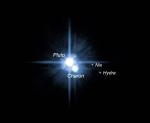
Discovered in mid-2005, Pluto's small moons were provisionally designated S/2005 P1 and S/2005 P2. They have now been officially christened Nix and Hydra. Compared to Pluto and its large moon Charon...
 Flying Past Pluto
6.10.2015
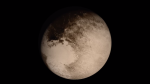
What would it look like to fly past Pluto? The robotic New Horizons spacecraft did just this in late July and continues to return stunning pictures of the dwarf planet. Some well-chosen flyby images have now been digitally sequenced to create the featured video.
|
January February March April May June July August September October |
|||||||||||||||||||||||||||||||||||||||||||||||||