
|
You entered: light
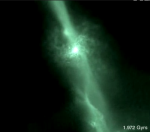 Simulation: A Disk Galaxy Forms
17.07.2012
How do galaxies like our Milky Way form? Since our universe moves too slowly to watch, faster-moving computer simulations are created to help find out. Green depicts (mostly) hydrogen gas in the above movie, while time is shown in billions of years since the Big Bang on the lower right.
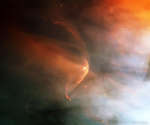 LL Orionis: When Cosmic Winds Collide
21.05.2016
What created this great arc in space? This arcing, graceful structure is actually a bow shock about half a light-year across, created as the wind from young star LL Orionis collides with the Orion Nebula flow.
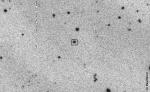 Optical Transient Near GRB970508 Shows Distant Redshift
13.05.1997
The GRB distance scale controversy may have just ended with a flash. Gamma Ray Bursts (GRBs) are powerful explosions occurring in seemingly random positions on the sky. They are so featureless and so poorly resolved, however, that their distances could not be determined.
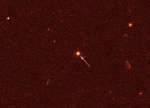 The GRB 110328A Symphony
19.04.2011
A symphony of planet-wide observations began abruptly on March 28 when the Earth-orbiting Swift satellite detected a burst of high-frequency gamma-rays from GRB 110328A. When the same source flared again after a 45 minute pause it was clear this event was not a typical gamma-ray burst.
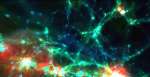 Illustris Simulation of the Universe
22.02.2020
How did we get here? Click play, sit back, and watch. A computer simulation of the evolution of the universe provides insight into how galaxies formed and perspectives into humanity's place in the universe.
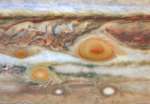 Jupiter s Three Red Spots
23.05.2008
For about 300 years Jupiter's banded atmosphere has shown a remarkable feature to telescopic viewers, a large swirling storm system known as The Great Red Spot. In 2006, another red storm system appeared, actually seen to form as smaller whitish oval-shaped storms merged and then developed the curious reddish hue.
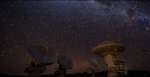 An ALMA Telescope Array Time Lapse
26.05.2014
It is the most expensive and complex ground-based astronomy project ever -- what will it see tonight? The Atacama Large Millimeter Array (ALMA) project consists of 66 dishes, many the size of a small house, situated in the high altitude Atacama Desert in Northern Chile.
 APOD: 2023 December 31 Б Illustris: A Simulation of the Universe
30.12.2023
How did we get here? Click play, sit back, and watch. A computer simulation of the evolution of the universe provides insight into how galaxies formed and perspectives into humanity's place in the universe.
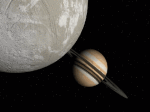 Worlds of a Distant Sun: 47 Ursae Majoris b
1.07.1996
Within the last few years, observational astronomy has given humanity evidence of the existence of worlds beyond the solar system. Indeed, solar-type stars are now inferred to harbor planets of approximately Jupiter mass - some residing in temperature zones which could conceivably support liquid water and therefore life!
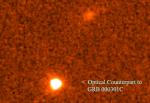 A GRB 000301C Symphony
3.06.2001
Last March, telescopic instruments in Earth and space tracked a tremendous explosion that occurred across the universe. A nearly unprecedented symphony of international observations began abruptly on 2000 March 1 when Earth-orbiting RXTE, Sun-orbiting Ulysses, and asteroid-orbiting NEAR all detected a 10-second burst of high-frequency gamma radiation. Within 48 hours astronomers
|
January February March April May June July August September October |
|||||||||||||||||||||||||||||||||||||||||||||||||