
|
You entered: tail
 APOD: 2024 November 6 Б Comet Tsuchinshan Atlas over the Dolomites
6.11.2024
Comet Tsuchinshan-Atlas is now headed back to the outer Solar System. The massive dusty snowball put on quite a show during its trip near the Sun, resulting in many impressive pictures from planet Earth during October. The featured image was taken in mid-October and shows a defining visual feature of the comet -- its impressive anti-tail.
 Comets and Bright Star
6.01.2016
This timely, telescopic, two panel mosaic spans about 10 full moons across planet Earth's predawn skies. Recorded as the year began from Tenerife, Canary Islands, near the top of the frame are the faint coma and tail of Comet Borrelly (P/19).
 Comet C 2002 T7 (LINEAR)
22.04.2004
Discovered by the the Lincoln Near Earth Asteroid Research (LINEAR) project in October of 2002, comet C/2002 T7 is now visiting the inner solar system, making its closest approach (see animation by L. Koehn) to the Sun tomorrow, April 23rd.
 Comet PanSTARRS with Galaxy
6.06.2014
Sweeping slowly through northern skies, the comet PanSTARRS C/2012 K1 posed for this telescopic portrait on June 2nd in the constellation Ursa Major. Now in the inner solar system, the icy body from the Oort cloud sports two tails, a lighter broad dust tail and crooked ion tail extending below and right.
 A Year of Spectacular Comets
31.12.2007
Two spectacular comets graced Earth's skies during 2007. Both comets became bright enough to be seen by the unaided eye of the casual sky enthusiast. Early in 2007, Comet McNaught grew brighter than any comet in 40 years, displaying a beautiful dust tail that flowed across the sky.
 APOD: 2025 January 28 Б Comet G3 ATLAS over Uruguay
28.01.2025
Comets can be huge. When far from the Sun, a comet's size usually refers to its hard nucleus of ice and rock, which typically spans a few kilometers -- smaller than even a small moon.
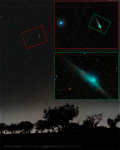 APOD: 2023 January 31 Б A Triple View of Comet ZTF
31.01.2023
Comet ZTF has a distinctive shape. The now bright comet visiting the inner Solar System has been showing not only a common dust tail, ion tail, and green gas coma, but also an uncommonly distinctive antitail.
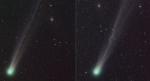 Comet C 2001 Q4 (NEAT)
23.04.2004
Inbound from the distant solar system, comet C/2001 Q4 will soon pass just inside planet Earth's orbit and should be one of two bright, naked-eye comets visible in southern skies in May. First...
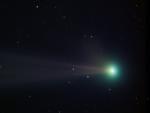 Colors of Comet Pojmanski
11.03.2006
Comet Pojmanski flew by planet Earth last weekend on a surprise trip through the inner solar system. Then an easy binocular target for morning skygazers, Pojmanski ultimately showed off a long tail, but it also presented some lovely green-blue hues as gas molecules in its tenuous coma and tail fluoresced in the sunlight.
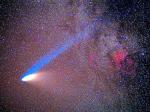 Comet Hale Bopp and the North America Nebula
3.10.2004
Comet Hale-Bopp's 1997 encounter with the inner Solar System allowed many breath-taking pictures. Above, Comet Hale-Bopp was photographed crossing the constellation of Cygnus, sporting spectacular yellow dust and blue ion tails. Visible on the right in red is the North America Nebula, a bright emission nebula observable from a dark location with binoculars.
|
January February March April May June July August September October |
|||||||||||||||||||||||||||||||||||||||||||||||||