
|
You entered: tail
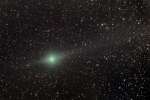 Comet Lulin Approaches
2.02.2009
How bright will Comet Lulin become? No one knows for sure. Although it is notoriously difficult to accurately predict the brightness of newly discovered comets, Comet Lulin could well become visible to the unaided eye later this month.
 APOD: 2023 September 9 Б Comet Nishimura Grows
9.09.2023
Comet Nishimura is growing. More precisely, the tails C/2023 P1 (Nishimura) are growing as it nears the Sun. Discovered only last month, the comet is already near naked eye brightness as it now moves inside the Earth's orbit.
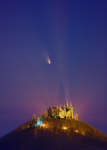 Comet Castle
22.03.2013
The broad dust tail of Comet PanSTARRS (C/2011 L4) has become a familiar sight for many northern hemisphere comet watchers, as the comet fades but rises higher above the western horizon after sunset. This view of the popular comet may seem a little fantastic, though.
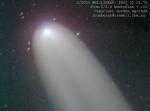 Comet LINEAR WM1 Shines in the South
4.02.2002
A new comet has brightened unexpectedly and is currently visible to unaided observers of southern skies. Comet C/2000 WM1 (LINEAR) is now reported by some observers to be at third magnitude, making it brighter -- although more diffuse -- than most visible stars. A dust tail as long as 3 degrees has also been reported.
 Comet 13P Olbers
28.06.2024
Not a paradox, Comet 13P/Olbers is returning to the inner Solar System after 68 years. The periodic, Halley-type comet will reach its next perihelion or closest approach to the Sun on June 30 and has become a target for binocular viewing low in planet Earth's northern hemisphere night skies.
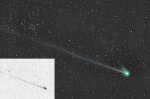 Comet McNaught Passes NGC 1245
17.06.2010
Of the many comets named for discoverer Robert McNaught, the one cataloged as C/2009 R1 is gracing dawn skies for northern hemisphere observers this month. Seen here on June 13th from southern New Mexico, this Comet McNaught's long ion tail sweeps across the telescopic field of view (a negative image is inset).
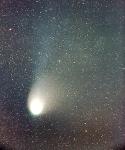 Comet Hale-Bopp Returns
6.02.1997
Comet Hale-Bopp has returned from behind the Sun. In December and early January, Comet Hale-Bopp was too near the Sun to be easily visible from Earth. Now the comet graces the morning sky and is visible from dark locations even without binoculars.
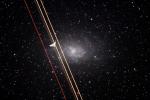 Just Passing Through
25.08.2007
M33 is a big, beautiful spiral galaxy a mere 3 million light-years away, understandably a popular target for enthusiastic astro-imagers. Just as understandably, interfering satellite trails and airplane streaks that are becoming more common in planet Earth's busy night sky are processed out of their finished images.
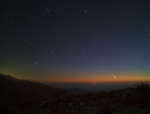 Comets Lemmon and PanSTARRS Peaking
5.03.2013
Two impressive comets will both reach their peak brightness during the next two weeks. Taking advantage of a rare imaging opportunity, both of these comets were captured in the sky together last week over the Atacama desert in South America.
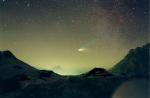 Comet Hale-Bopp Over Val Parola Pass
27.05.2001
Comet Hale-Bopp became much brighter than any surrounding stars. It was seen even over bright city lights. Out away from city lights, however, it put on quite a spectacular show. Here Comet Hale-Bopp was photographed above Val Parola Pass in the Dolomite mountains surrounding Cortina d'Ampezzo, Italy.
|
January February March April May June July August September October |
|||||||||||||||||||||||||||||||||||||||||||||||||