
|
You entered: color
 NGC 7822 in Cepheus
28.08.2009
Pillars of gas, dust, and young, hot stars fill the center of NGC 7822. At the edge of a giant molecular cloud toward the northern constellation Cepheus, the glowing star forming region lies about 3,000 light-years away. Within the nebula, bright edges and tantalizing shapes are highlighted in this colorful skyscape.
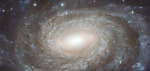 NGC 6384: Spiral Beyond the Stars
6.07.2013
The universe is filled with galaxies. But to see them astronomers must look out beyond the stars of our own galaxy, the Milky Way. This colorful Hubble Space Telescopic portrait features spiral galaxy NGC 6384, about 80 million light-years away in the direction of the constellation Ophiuchus.
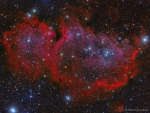 IC 1848: The Soul Nebula
28.02.2016
Stars are forming in the Soul of the Queen of Aethopia. More specifically, a large star forming region called the Soul Nebula can be found in the direction of the constellation Cassiopeia, who Greek mythology credits as the vain wife of a King who long ago ruled lands surrounding the upper Nile river.
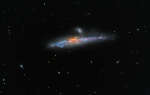 NGC 4631: The Whale Galaxy
3.06.2016
NGC 4631 is a big beautiful spiral galaxy. Seen edge-on, it lies only 25 million light-years away in the well-trained northern constellation Canes Venatici. The galaxy's slightly distorted wedge shape suggests to some a cosmic herring and to others its popular moniker, The Whale Galaxy.
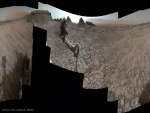 Curiosity at Murray Buttes on Mars
24.08.2016
What are these unusual lumps on Mars? As NASA's robotic Curiosity rover continues rolling across Mars, it is now approaching Murray Buttes. Several of the 15-meter high buttes are visible ahead in this horizontally compressed 360-degree across image taken inside Gale Crater earlier this month.
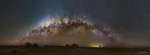 The Milky Way Sets
26.08.2016
Under dark skies the setting of the Milky Way can be a dramatic sight. Stretching nearly parallel to the horizon, this rich, edge-on vista of our galaxy above the dusty Namibian desert stretches from bright, southern Centaurus (left) to Cepheus in the north (right).
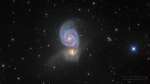 M51: The Whirlpool Galaxy
19.10.2017
Find the Big Dipper and follow the handle away from the dipper's bowl until you get to the last bright star. Then, just slide your telescope a little south and west and you'll come upon this stunning pair of interacting galaxies, the 51st entry in Charles Messier's famous catalog.
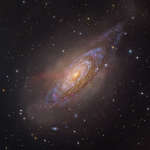 NGC 3521: Galaxy in a Bubble
5.05.2022
Gorgeous spiral galaxy NGC 3521 is a mere 35 million light-years away, toward the northern springtime constellation Leo. Relatively bright in planet Earth's sky, NGC 3521 is easily visible in small telescopes but often overlooked by amateur imagers in favor of other Leo spiral galaxies, like M66 and M65.
 APOD: 2023 May 10 Б Milky Way over Egyptian Desert
10.05.2023
For ten years the stargazer dreamed of taking a picture like this. The dreamer knew that the White Desert National Park in Egypt's Western Desert is a picturesque place hosting numerous chalk formations sculpted into surreal structures by a sandy wind.
 The Dark Horsehead Nebula
29.12.2000
While drifting through the cosmos, sculpted by stellar winds and radiation, this magnificent interstellar dust cloud has chanced to assume a recognizable shape. Fittingly named The Horsehead Nebula it is embedded in the immense complex of star forming gas and dust surrounding the Orion Nebula some 1,500 light-years distant.
|
January February March April May June July August September October |
|||||||||||||||||||||||||||||||||||||||||||||||||