
|
You entered: color
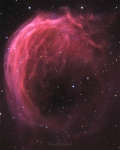 APOD: 2026 September 29 Б Sh2 188: The Shrimp Nebula
29.09.2026
What causes the swirl in the Shrimp Nebula? Its high speed is likely. What is sure is that Sh2-188 is one of the larger planetary nebulas on the night sky, by angular size, spanning about half the diameter of the Moon.
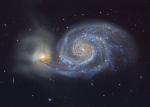 M51: Cosmic Whirlpool
10.07.2002
Follow the handle of the Big Dipper away from the dipper's bowl, until you get to the handle's last bright star. Then, just slide your telescope a little south and west and you'll likely find this stunning pair of interacting galaxies, the 51st entry in Charles Messier's famous catalog.
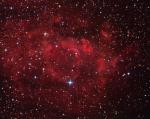 Stars and the Bubble Nebula
17.01.2003
Seemingly adrift in an cosmic sea of stars and gas, this delicate, floating apparition is cataloged as NGC 7635 -- The Bubble Nebula. In this wide-angle view, the Bubble nebula lies at the center of a larger complex of shocked glowing gas about 11,000 light-years distant in the fair constellation Cassiopeia.
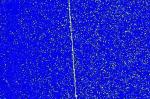 An Anomalous SETI Signal
7.03.2004
No one knows for sure what caused this signal. There is a slight possibility that it just might originate from an extraterrestrial intelligence. The bright colors on the blue background indicate that an anomalous signal was received here on Earth by a radio telescope involved in a Search for Extraterrestrial Intelligence (SETI).
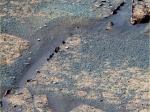 Razorbacks in Endurance Crater
27.07.2004
Over one year after its launch, robot geologist Opportunity has been spending recent sols on Mars inching its way down the slopes of Endurance crater. Littered with martian blueberries, some flat rocks within the crater also seem to have surprising razorbacks -- narrow slabs sticking up along their edges.
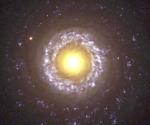 Seyfert Galaxy NGC 7742
23.10.1998
This might resemble a fried egg you've had for breakfast, but it's actually much larger. In fact, ringed by blue-tinted star forming regions and faintly visible spiral arms, the yolk-yellow center of this face-on spiral galaxy, NGC 7742, is about 3,000 light-years across.
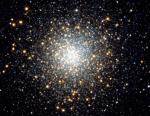 Hydrogen, Helium, and the Stars of M10
12.03.1999
Stars like the Sun use hydrogen for fuel, "burning" hydrogen into helium at their cores through nuclear fusion. But what happens when that hydrogen runs out? For a while, hydrogen burns in a shell surrounding the stellar core and the star expands to become a red giant.
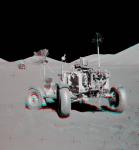 Apollo 17: VIP Site Anaglyph
26.08.2006
Get out your red/blue glasses and check out this stereo scene from Taurus-Littrow valley on the Moon! The color anaglyph features a detailed 3D view of Apollo 17's Lunar Rover in the foreground -- behind it lies the Lunar Module and distant lunar hills.
 The Medusa Nebula
23.11.2007
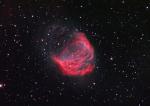
Braided, serpentine filaments of glowing gas suggest this nebula's popular name, The Medusa Nebula. Also known as Abell 21, this Medusa is an old planetary nebula some 1,500 light-years away in the constellation Gemini. Like its mythological namesake, the nebula is associated with a dramatic transformation.
 Stars at the Galactic Center
14.06.2009
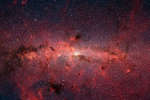
The center of our Milky Way Galaxy is hidden from the prying eyes of optical telescopes by clouds of obscuring dust and gas. But in this stunning vista, the Spitzer Space Telescope's infrared cameras, penetrate much of the dust revealing the stars of the crowded galactic center region.
|
January February March April May June July August September October |
|||||||||||||||||||||||||||||||||||||||||||||||||