
|
You entered: color
RGBpugh1024.preview.jpg) One Armed Spiral Galaxy NGC 4725
One Armed Spiral Galaxy NGC 4725
16.04.2015
While most spiral galaxies, including our own Milky Way, have two or more spiral arms, NGC 4725 has only one. In this sharp color composite image, the solo spira mirabilis seems to wind from a prominent ring of bluish, newborn star clusters and red tinted star forming regions.
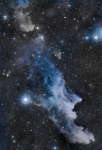 The Witch Head Nebula
30.10.2015
Double, double toil and trouble; Fire burn, and cauldron bubble .... maybe Macbeth should have consulted the Witch Head Nebula. A suggestively shaped reflection nebula, this cosmic crone is about 800 light-years away though. Its frightening visage seems to glare toward nearby bright star Rigel in Orion, just off the right edge of this frame.
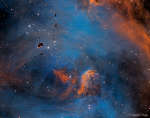 Stars and Globules in the Running Chicken Nebula
20.01.2016
The eggs from this gigantic chicken may form into stars. The featured emission nebula, shown in scientifically assigned colors, is cataloged as IC 2944 but known as the Running Chicken Nebula for the shape of its greater appearance. Seen toward the top of the image are small, dark molecular clouds rich in obscuring cosmic dust.
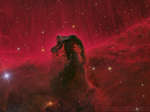 The Horsehead Nebula
17.12.2019
Sculpted by stellar winds and radiation, a magnificent interstellar dust cloud by chance has assumed this recognizable shape. Fittingly named the Horsehead Nebula, it is some 1,500 light-years distant, embedded in the vast Orion cloud complex.
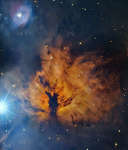 Alnitak and the Flame Nebula
12.04.2021
What lights up the Flame Nebula? Fifteen hundred light years away towards the constellation of Orion lies a nebula which, from its glow and dark dust lanes, appears, on the left, like a billowing fire. But fire, the rapid acquisition of oxygen, is not what makes this Flame glow.
 The Fairy of Eagle Nebula
25.09.2022
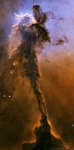
The dust sculptures of the Eagle Nebula are evaporating. As powerful starlight whittles away these cool cosmic mountains, the statuesque pillars that remain might be imagined as mythical beasts. Featured here is one of several striking dust pillars of the Eagle Nebula that might be described as a gigantic alien fairy.
 APOD: 2024 September 2 Б A Triangular Prominence Hovers Over the Sun
2.09.2024
Why is there a triangle hovering over the Sun? Although the shape is unusual, the type of structure is not: it is part of an evolving solar prominence. Looping magnetic fields on the Sun channel the flow of energetic particles, sometimes holding glowing gaseous structures aloft for months.
 IC 4406: A Seemingly Square Nebula
18.06.2002
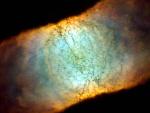
How can a round star make a square nebula? This conundrum comes to light when studying planetary nebulae like IC 4406. Evidence indicates that IC 4406 is likely a hollow cylinder, with its square appearance the result of our vantage point in viewing the cylinder from the side.
 Blue Sun Glaring
6.01.1997
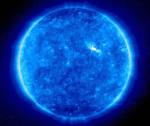
The Sun is a bubbling ball of extremely hot gas. In this false-color picture, light blue regions are extremely hot - over 1 million degrees, while dark blue regions are slightly cooler. The camera filter used was highly sensitive to the emission of highly charged iron ions, which trace the magnetic field of the Sun.
 Fractal Interstellar Dust Up Close
6.07.2003
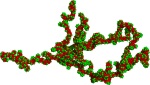
Our universe is a very dusty place. Dust usually shows its presence by blocking out light emitted from stars or nebulae behind it, sometimes creating the illusion of a horse's head or a sombrero hat. But nobody really knows what a typical interstellar dust grain looks like.
|
January February March April May June July August September October |
|||||||||||||||||||||||||||||||||||||||||||||||||