
|
You entered: color
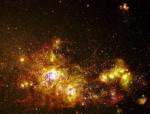 NGC 4214: Star Forming Galaxy
7.01.2000
Dazzling displays of star formation abound across the face of galaxy NGC 4214, a mere 13 million light-years away in the northern constellation Canes Venatici. While this 1997 Hubble Space Telescope image shows...
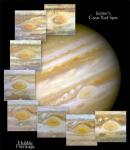 Hubble Tracks Jupiters Great Red Spot
6.08.1999
It is a hurricane twice the size of the Earth. It has been raging at least as long as telescopes could see it, and shows no signs of slowing. It is Jupiter's Great Red Spot, the largest swirling storm system in the Solar System.
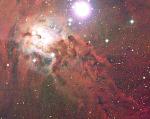 The Fox Fur Nebula
1.07.2002
The nebula surrounding bright star S Mon is filled with dark dust and glowing gas. The strange shapes that surrounding this star originate from fine interstellar dust reacting in complex ways with the energetic light and hot gas being expelled by the young stars.
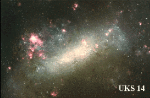 The Large Cloud of Magellan (LMC)
23.10.1996
Magellan and his crew had plenty of time to study the southern sky during their famous voyage around the world. As a result, two fuzzy cloud like objects in the southern sky are now known as the Clouds of Magellan. These star clouds are small irregular galaxies, satellites of our larger Milky Way spiral galaxy.
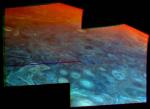 Hazing Jupiter
9.01.1997
A dramatic mosaic of recent images from the Galileo spacecraft reveals details of swirling clouds and a thick stratospheric haze in the atmosphere of Jupiter, the Solar System's largest planet. This false color...
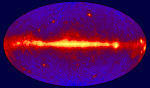 The Gamma Ray Sky
22.02.1997
What if you could "see" gamma rays? If you could, the sky would seem to be filled with a shimmering high-energy glow from the most exotic and mysterious objects in the Universe.
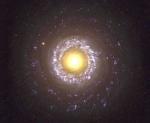 Spiral Galaxy NGC 7742
26.07.2003
This might resemble a fried egg you've had for breakfast, but it's actually much larger. In fact, ringed by blue-tinted star forming regions and faintly visible spiral arms, the yolk-yellow center of this face-on spiral galaxy, NGC 7742, is about 3,000 light-years across.
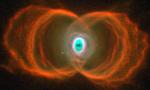 MyCn18: An Hourglass Nebula
14.09.1997
The sands of time are running out for the central star of this hourglass-shaped planetary nebula. With its nuclear fuel exhausted, this brief, spectacular, closing phase of a Sun-like star's life occurs as its outer layers are ejected - its core becoming a cooling, fading white dwarf.
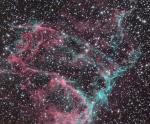 IC1340 in the Eastern Veil
26.09.2003
These ghostly filaments of interstellar gas are just a small part of the expansive Veil Nebula, seen against a rich field of background stars in the long-necked constellation Cygnus. Also known as the Cygnus...
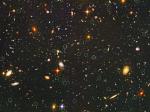 HUDF: Dawn of the Galaxies
29.09.2004
When did galaxies form? Faint red smudges identified on the deepest optical sky image ever taken may well be members of the first class of galaxies. Detailed inspection of the Hubble Ultra Deep Field...
|
January February March April May June July August September October |
|||||||||||||||||||||||||||||||||||||||||||||||||