
|
You entered: color
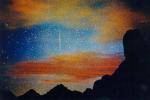 Leonid Sunrise
17.11.2000
Such beautiful things begin as grains of sand. Locked in an oyster a granule grows into an iridescent pearl, lustrous and lovely to behold. While hurtling through the atmosphere at 70 kilometers per second, a cosmic sand grain becomes an awe-inspiring meteor, its transient beauty displayed for any who care to watch.
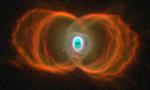 MyCn18: An Hourglass Nebula
4.06.2000
The sands of time are running out for the central star of this hourglass-shaped planetary nebula. With its nuclear fuel exhausted, this brief, spectacular, closing phase of a Sun-like star's life occurs as its outer layers are ejected - its core becoming a cooling, fading White Dwarf.
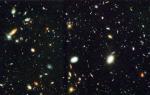 The Hubble Deep Field
9.07.2000
Galaxies like colorful pieces of candy fill the Hubble Deep Field - one of humanity's most distant optical views of the Universe. The dimmest, some as faint as 30th magnitude (about four billion times...
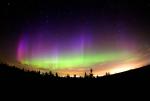 Northern Lights
30.07.2004
While enjoying the spaceweather on a gorgeous summer evening in mid-July, astronomer Philippe Moussette captured this colorful fish-eye lens view looking north from the Observatoire Mont Cosmos, Quebec, Canada, planet Earth. In the foreground, lights along the northern horizon give an orange cast to the low clouds.
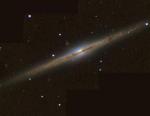 Edge On Spiral Galaxy NGC 891
20.12.1998
Is our Galaxy this thin? We believe so. The Milky Way, like NGC 891 pictured above, has the width of a typical spiral galaxy. Spirals have most of their bright stars, gas, and obscuring dust in a thin disk.
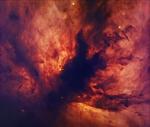 Flame Nebula Close Up
2.02.2007
Of course, the Flame Nebula is not on fire. Also known as NGC 2024, the nebula's suggestive reddish color is due to the glow of hydrogen atoms at the edge of the giant Orion molecular cloud complex some 1,500 light-years away.
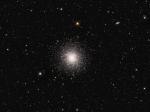 M13: The Great Globular Cluster in Hercules
18.05.2007
In 1714, Edmond Halley noted that M13 "shows itself to the naked eye when the sky is serene and the Moon absent." Of course, M13 is now modestly recognized as the Great Globular Cluster in Hercules, one of the brightest globular star clusters in the northern sky.
 NGC 3621: Far Beyond the Local Group
19.09.2009
Far beyond the local group of galaxies lies NGC 3621, some 22 million light-years away. Found in the multi-headed southern constellation Hydra, the winding spiral arms of this gorgeous island universe are loaded with luminous young star clusters and dark dust lanes.
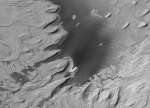 Ancient Layered Hills on Mars
29.11.2009
Is this a picture of Mars or Earth? Oddly enough, it is a picture of Mars. What may appear to some as a terrestrial coastline is in fact a formation of ancient layered hills and wind-blown sand on Mars. The above-pictured region spans about three kilometers in Schiaparelli Crater.
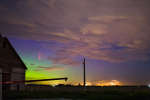 Stars, Sprites, Clouds, Auroras
3.02.2015
What are those red streaks in the sky? While photographing unexpected auroras over a distant thunderstorm, something extraordinary happened: red sprites. This brief instance of rarely imaged high-altitude lightning flashed so bright that it was witnessed by several people independently.
|
January February March April May June July August September October |
|||||||||||||||||||||||||||||||||||||||||||||||||