
|
You entered: color
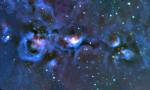 NGC 6334: The Bear Claw Nebula
6.04.1999
NGC 6334 is a cloud of gas and dust that appears to be forming massive stars. At 5500 light-years away, the Bear Claw Nebula, as it has also been dubbed, is more than three times as distant as the Orion Nebula, but still close enough for detailed study.
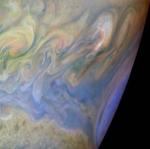 West Of The Great Red Spot
26.12.1999
The turbulent region West of Jupiter's Great Red Spot is highlighted in this picture constructed from data recorded by the Galileo spacecraft. The image is color coded to show cloud height and thickness; white clouds are high and thick, light blue clouds are high and thin, and reddish clouds are low.
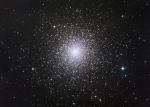 Globular Star Cluster M3
9.06.2007
This immense ball of half a million stars older than the Sun lies over 30,000 light-years away. Cataloged as M3 (and NGC 5272), it is one of about 150 globular star clusters that roam the halo of our Milky Way Galaxy.
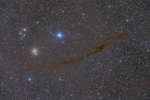 The Dark Doodad Nebula
8.12.2008
What is that strange dark ribbon on the sky? When observing the great globular cluster NGC 4372, observers frequently take note of a strange dark streak nearly three degrees in length running near it. Unnamed, the streak, actually a long molecular cloud, has become known as the Dark Doodad Nebula.
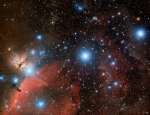 Alnitak, Alnilam, Mintaka
21.01.2011
Alnitak, Alnilam, and Mintaka, are the bright bluish stars from east to west (left to right) along the diagonal in this gorgeous cosmic vista. Otherwise known as the Belt of Orion, these three blue supergiant stars are hotter and much more massive than the Sun.
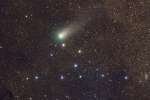 Comet Garradd and the Coat Hanger
9.09.2011
Sweeping through planet Earth's night sky, last weekend Comet Garradd (C/2009 P1) visited this lovely star field along the Milky Way in the constellation Vulpecula. Suggestively oriented, the colorful skyscape features stars in the asterism known as the Coat Hanger with the comet's tail pointing toward the southeast.
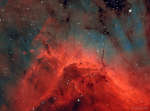 Pillars and Jets in the Pelican Nebula
3.03.2015
What dark structures arise from the Pelican Nebula? Visible as a bird-shaped nebula toward the constellation of a bird (Cygnus, the Swan), the Pelican Nebula is a place dotted with newly formed stars but fouled with dark dust.
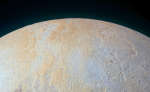 Northern Pluto
27.02.2016
Gaze across the frozen canyons of northern Pluto in this contrast enhanced color scene, imaged last July by the New Horizons spacecraft. Currently known as Lowell Regio, the region has been informally named for Percival Lowell, founder of the Lowell Observatory.
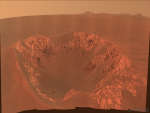 Intrepid Crater on Mars from Opportunity
4.04.2018
The robotic rover Opportunity sometimes passes small craters on Mars. Pictured here in 2010 is Intrepid Crater, a 20-meter across impact basin slightly larger than Nereus Crater that Opportunity had chanced across previously. The featured image is in approximately true color but horizontally compressed to accommodate a wide angle panorama.
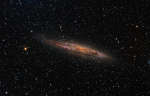 Nearby Spiral Galaxy NGC 4945
22.08.2019
Large spiral galaxy NGC 4945 is seen edge-on near the center of this cosmic galaxy portrait. In fact, it's almost the size of our Milky Way Galaxy. NGC 4945's own dusty disk, young blue star clusters, and pink star forming regions standout in the sharp, colorful telescopic image.
|
January February March April May June July August September October |
|||||||||||||||||||||||||||||||||||||||||||||||||