
|
You entered: color
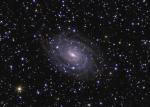 NGC 6384: Beyond the Stars
12.07.2007
The universe is filled with galaxies. But to see them astronomers must look out beyond the stars of our galaxy, the Milky Way. For example, consider this colorful telescopic view of spiral galaxy NGC 6384, about 80 million light-years away in the direction of the constellation Ophiuchus.
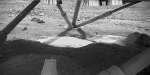 Unusual Light Patch Under Phoenix Lander on Mars
2.06.2008
Is that ice under the Phoenix spacecraft on Mars? Quite possibly. Phoenix, which landed a week ago, was expected to dig under the Martian soil to search for ice, but the lander's breaking jets may already have uncovered some during descent.
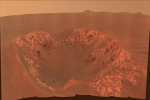 Intrepid Crater on Mars
8.12.2010
The robotic rover Opportunity has chanced across another small crater on Mars. Pictured above is Intrepid Crater, a 20-meter across impact basin slightly larger than Nereus Crater that Opportunity chanced across last year. The above image is in approximately true color but horizontally compressed to accommodate a wide angle panorama.
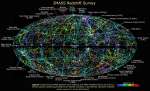 The Universe Nearby
14.06.2011
What does the universe nearby look like? This plot shows nearly 50,000 galaxies in the nearby universe detected by the Two Micron All Sky Survey (2MASS) in infrared light. The resulting image is anincredible tapestry of galaxies that provides limits on how the universe formed and evolved.
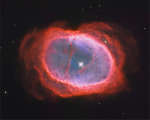 NGC 3132: The Southern Ring Nebula
9.04.2013
It's the dim star, not the bright one, near the center of NGC 3132 that created this odd but beautiful planetary nebula. Nicknamed the Eight-Burst Nebula and the Southern Ring Nebula, the glowing gas originated in the outer layers of a star like our Sun.
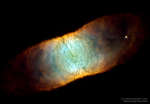 IC 4406: A Seemingly Square Nebula
8.01.2017
How can a round star make a square nebula? This conundrum comes to light when studying planetary nebulae like IC 4406. Evidence indicates that IC 4406 is likely a hollow cylinder, with its square appearance the result of our vantage point in viewing the cylinder from the side.
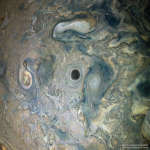 Jupiter Abyss
10.06.2019
What's that black spot on Jupiter? No one is sure. During the latest pass of NASA's Juno around Jupiter, the robotic spacecraft imaged an usually dark cloud feature informally dubbed the Abyss. Surrounding cloud patterns show the Abyss to be at the center of a vortex.
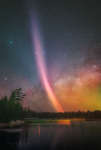 STEVE over Copper Harbor
5.05.2021
What creates STEVEs? Strong Thermal Emission Velocity Enhancements (STEVEs) have likely been seen since antiquity, but only in the past five years has it been realized that their colors and shapes make them different from auroras. Seen as single bright streaks of pink and purple, the origin of STEVEs remain an active topic of research.
 APOD: 2023 August 7 Б The Pelican Nebula in Gas, Dust, and Stars
7.08.2023
The Pelican Nebula is slowly being transformed. IC 5070 (the official designation) is divided from the larger North America Nebula by a molecular cloud filled with dark dust. The Pelican, however, receives much study because it is a particularly active mix of star formation and evolving gas clouds.
 NGC 1365: Majestic Island Universe
1.02.2024
Barred spiral galaxy NGC 1365 is truly a majestic island universe some 200,000 light-years across. Located a mere 60 million light-years away toward the faint but heated constellation Fornax, NGC 1365 is a dominant member of the well-studied Fornax Cluster of galaxies.
|
January February March April May June July August September October |
|||||||||||||||||||||||||||||||||||||||||||||||||