
|
You entered: space
 Into the Void
6.06.2015
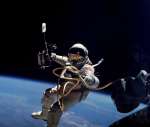
Fifty years ago, on June 3, 1965, Edward White stepped out of the orbiting Gemini 4 spacecraft to become the first US astronaut to walk in space. White is captured in this photo taken...
 Facing NGC 3344
13.04.2018
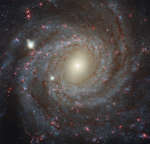
From our vantage point in the Milky Way Galaxy, we see NGC 3344 face-on. Nearly 40,000 light-years across, the big, beautiful spiral galaxy is located just 20 million light-years away in the constellation of Leo Minor. This multi-color Hubble Space Telescope close-up of NGC 3344 includes remarkable details from near infrared to ultraviolet wavelengths.
 Galaxies Away
25.05.2018
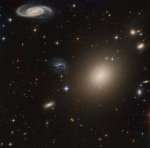
This stunning group of galaxies is far, far away, about 450 million light-years from planet Earth and cataloged as galaxy cluster Abell S0740. Dominated by the cluster's large central elliptical galaxy (ESO 325-G004)...
 Unexpected Trajectory Interstellar Asteroid Oumuamua
20.11.2018
Why is 'Oumuamua differing from its expected trajectory? Last year, 1I/2017 U1 'Oumuamua became the first known asteroid from interstellar space to pass through our Solar System. Just over a year ago, this tumbling interstellar rock even passed rather close to the Earth.
 Planet Earth at Night II
17.06.2023
Recorded during 2017, timelapse sequences from the International Space Station are compiled in this serene video of planet Earth at Night. Fans of low Earth orbit can start by enjoying the view as green and red aurora borealis slather up the sky.
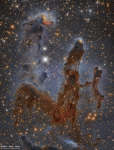 APOD: 2026 May 31 Б Eagle Nebula Pillars in Infrared from Hubble
31.05.2026
Newborn stars are forming in the Eagle Nebula. They are gravitationally contracting in pillars of dense gas and dust. The intense radiation of these newly-formed bright stars is causing surrounding material to boil away.
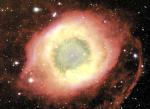 The Helix Nebula from CFHT
28.08.2000
One day our Sun may look like this. The Helix Nebula is the closest example of a planetary nebula created at the end of the life of a Sun-like star. The outer gasses of the star expelled into space appear from our vantage point as if we are looking down a helix.
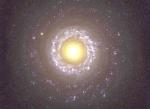 Spiral Galaxy NGC 7742
1.07.2001
This might resemble a fried egg you've had for breakfast, but it's actually much larger. In fact, ringed by blue-tinted star forming regions and faintly visible spiral arms, the yolk-yellow center of this face-on spiral galaxy, NGC 7742, is about 3,000 light-years across.
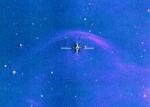 Runaway Star
3.12.1997
Runaway stars are massive stars traveling rapidly through interstellar space. Like a ship plowing through the interstellar medium, runaway star HD 77581 has produced this graceful arcing bow wave or "bow shock" - compressing the gaseous material in its path.
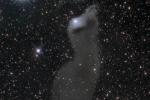 vdB 152: Reflection Nebula in Cepheus
14.06.2007
Described as a "dusty curtain" or "ghostly apparition", mysterious reflection nebula vdB 152 really is very faint. It lies about 1400 light-years away, along the northern Milky Way in the royal constellation Cepheus. Near...
|
January February March April May June July August September October |
|||||||||||||||||||||||||||||||||||||||||||||||||