
|
You entered: space
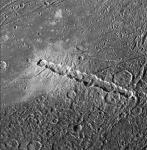 Ganymede: Torn Comet Crater Chain
15.12.2001
This striking line of 13 closely spaced craters on Jupiter's moon Ganymede was photographed by the Galileo spacecraft in 1997. The picture covers an area about 120 miles wide and the chain of craters cuts across a sharp boundary between dark and light terrain. What caused this crater chain?
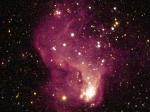 Star Forming Region Hubble V
25.12.2001
How did stars form in the early universe? Astronomers are gaining insight by studying NGC 6822, a nearby galaxy classified as irregular by modern standards but appearing more typical of galaxies billions of years ago. Inspection of NGC 6822 shows several bright star groups, including two dubbed Hubble-X and Hubble-V.
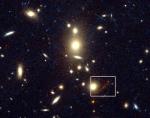 Behind CL1358+62: A New Farthest Object
31.07.1997
What if we could see back to the beginning of the universe? At one tenth the universe's present age, we might see galaxies forming. But what did galaxies look like when they were forming?
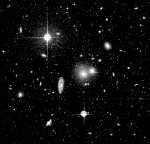 The Hydra Cluster of Galaxies
9.08.1997
You are flying through space and come to ... the Hydra Cluster of Galaxies. Listed as Abell 1060, the Hydra Cluster contains well over 100 bright galaxies. Clusters of galaxies are the largest gravitationally-bound objects in the universe.
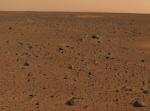 Red Mars from Spirit
7.01.2004
Rocks are strewn across the broad, flat Gusev crater floor in this sharp color picture from NASA's Spirit rover. Recorded by the rover's panoramic camera, the picture is part of Spirit's first color image of Mars - the highest resolution picture yet taken on the surface of another planet.
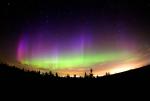 Northern Lights
30.07.2004
While enjoying the spaceweather on a gorgeous summer evening in mid-July, astronomer Philippe Moussette captured this colorful fish-eye lens view looking north from the Observatoire Mont Cosmos, Quebec, Canada, planet Earth. In the foreground, lights along the northern horizon give an orange cast to the low clouds.
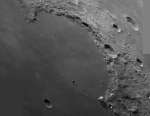 The Bay of Rainbows
8.02.2008
Dark, smooth regions that cover the Moon's familiar face are called by Latin names for oceans and seas. The naming convention is historical, though it may seem a little ironic to denizens...
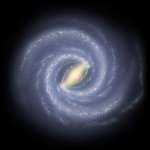 Two Armed Spiral Milky Way
6.06.2008
Gazing out from within the Milky Way, our own galaxy's true structure is difficult to discern. But an ambitious survey effort with the Spitzer Space Telescope now offers convincing evidence that we live...
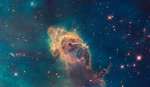 Carina Pillar and Jets
1.10.2009
This cosmic pillar of gas and dust is nearly 2 light-years wide. The structure lies within one of our galaxy's largest star forming regions, the Carina Nebula, shining in southern skies at a distance of about 7,500 light-years.
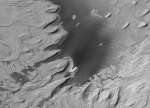 Ancient Layered Hills on Mars
29.11.2009
Is this a picture of Mars or Earth? Oddly enough, it is a picture of Mars. What may appear to some as a terrestrial coastline is in fact a formation of ancient layered hills and wind-blown sand on Mars. The above-pictured region spans about three kilometers in Schiaparelli Crater.
|
January February March April May June July August September October |
|||||||||||||||||||||||||||||||||||||||||||||||||