
|
You entered: apod
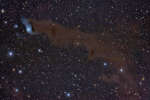 In Wolf s Cave
19.11.2011
The mysterious blue reflection nebula found in catalogs as VdB 152 or Ced 201 really is very faint. It lies at the tip of the long dark nebula Barnard 175 in a dusty complex that has also been called Wolf's Cave.
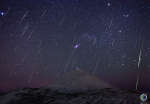 Geminid Meteors over Teide Volcano
17.12.2013
On some nights it rains meteors. Peaking two nights ago, asteroid dust streaked through the dark skies of Earth, showering down during the annual Geminids meteor shower. Astrophotographer Juan Carlos Casado captured the space weather event, as pictured above, in a series of exposures spanning about 2.3 hours using a wide angle lens.
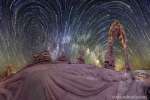 Warped Sky: Star Trails over Arches National Park
17.03.2014
What's happened to the sky? A time warp, of sorts, and a digital space warp too. The time warp occurs because this image captured in a single frame a two and a half hour exposure of the night sky. As a result, prominent star trails are visible.
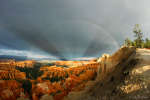 Rainbows and Rays over Bryce Canyon
28.07.2015
What's happening over Bryce Canyon? Two different optical effects that were captured in one image taken earlier this month. Both effects needed to have the Sun situated directly behind the photographer. The nearest...
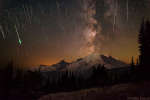 Meteors and Milky Way over Mount Ranier
25.08.2015
Despite appearances, the sky is not falling. Two weeks ago, however, tiny bits of comet dust were. Featured here is the Perseids meteor shower as captured over Mt. Rainier, Washington, USA. The image was created from a two-hour time lapse video, snaring over 20 meteors, including one that brightened dramatically on the image left.
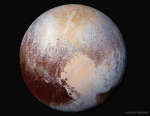 Pluto in Enhanced Color
31.08.2015
Pluto is more colorful than we can see. Color data and images of our Solar System's most famous dwarf planet, taken by the robotic New Horizons spacecraft during its flyby in July, have been digitally combined to give an enhanced view of this ancient world sporting an unexpectedly young surface.
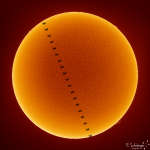 The Space Station Crosses a Spotless Sun
28.10.2019
Typically, the International Space Station is visible only at night. Slowly drifting across the night sky as it orbits the Earth, the International Space Station (ISS) can be seen as a bright spot about once a month from many locations.
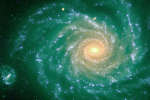 Grand Spiral Galaxy NGC 1232
24.08.2008
Galaxies are fascinating not only for what is visible, but for what is invisible. Grand spiral galaxy NGC 1232, captured in detail by one of the new Very Large Telescopes, is a good example.
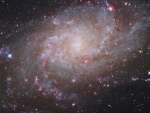 M33: Triangulum Galaxy
13.09.2008
The small, northern constellation Triangulum harbors this magnificent face-on spiral galaxy, M33. Its popular names include the Pinwheel Galaxy or just the Triangulum Galaxy. M33 is over 50,000 light-years in diameter, third largest in the Local Group of galaxies after the Andromeda Galaxy (M31), and our own Milky Way.
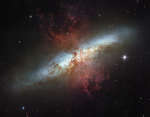 M82: Galaxy with a Supergalactic Wind
19.12.2010
What's lighting up the Cigar Galaxy? M82, as this irregular galaxy is also known, was stirred up by a recent pass near large spiral galaxy M81. This doesn't fully explain the source of the red-glowing outwardly expanding gas, however.
|
January February March April May June July August |
||||||||||||||||||||||||||||||||||||||||||||||||||||||||