
|
You entered: apod
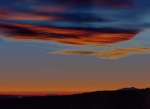 Mercury on the Horizon
19.02.2013
Have you ever seen the planet Mercury? Because Mercury orbits so close to the Sun, it never wanders far from the Sun in Earth's sky. If trailing the Sun, Mercury will be visible low on the horizon for only a short while after sunset.
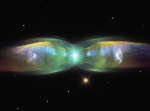 M2 9: Wings of a Butterfly Nebula
15.09.2013
Are stars better appreciated for their art after they die? Actually, stars usually create their most artistic displays as they die. In the case of low-mass stars like our Sun and M2-9 pictured above, the stars transform themselves from normal stars to white dwarfs by casting off their outer gaseous envelopes.
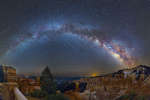 Meteors, Planes, and a Galaxy over Bryce Canyon
19.05.2014
Sometimes land and sky are both busy and beautiful. The landscape pictured in the foreground encompasses Bryce Canyon in Utah, USA, famous for its many interesting rock structures eroded over millions of years.
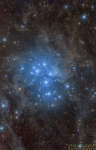 Pleiades: The Seven Sisters Star Cluster
9.09.2020
Have you ever seen the Pleiades star cluster? Even if you have, you probably have never seen it as large and clear as this. Perhaps the most famous star cluster on the sky, the bright stars of the Pleiades can be seen without binoculars from even the depths of a light-polluted city.
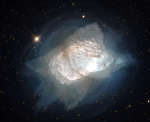 Bright Planetary Nebula NGC 7027 from Hubble
26.08.2013
It is one of the brightest planetary nebulae on the sky -- what should it be named? First discovered in 1878, nebula NGC 7027 can be seen toward the constellation of the Swan (Cygnus) with a standard backyard telescope.
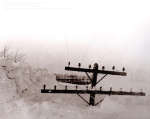 The Upper Michigan Blizzard of 1938
22.01.2014
Yes, but can your blizzard do this? In Upper Michigan's Storm of the Century in 1938, some snow drifts reached the level of utility poles. Nearly a meter of new and unexpected snow fell over two days in a storm that started 76 years ago tomorrow.
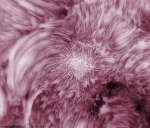 Fibrils Flower on the Sun
16.02.2015
When does the Sun look like a flower? In a specific color of red light emitted by hydrogen, as featured here, some regions of the solar chromosphere may resemble a rose. The color-inverted image was taken in 2014 October and shows active solar region 2177.
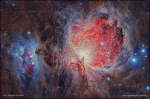 M42: The Great Orion Nebula
29.11.2017
Few astronomical sights excite the imagination like the nearby stellar nursery known as the Orion Nebula. The Nebula's glowing gas surrounds hot young stars at the edge of an immense interstellar molecular cloud.
 M16: Inside the Eagle Nebula
28.12.2020
From afar, the whole thing looks like an Eagle. A closer look at the Eagle Nebula, however, shows the bright region is actually a window into the center of a larger dark shell of dust. Through this window, a brightly-lit workshop appears where a whole open cluster of stars is being formed.
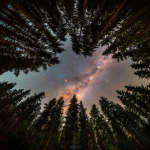 Framed by Trees: A Window to the Galaxy
19.07.2021
The photographer had this shot in mind for some time. He knew that objects overhead are the brightest -- since their light is scattered the least by atmospheric air. He also that knew the core of our Milky Way Galaxy was just about straight up near midnight around this time of year in South Australia.
|
January February March April May June July August |
||||||||||||||||||||||||||||||||||||||||||||||||||||||||