
|
You entered: gas
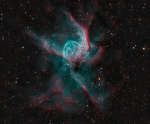 NGC 2359: Thor s Helmet
15.02.2014
This helmet-shaped cosmic cloud with wing-like appendages is popularly called Thor's Helmet. Heroically sized even for a Norse god, Thor's Helmet is about 30 light-years across. In fact, the helmet is more...
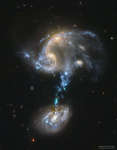 Arp 194: Merging Galaxy Group
25.03.2019
Why are stars forming in the bridge between these colliding galaxies? Usually when galaxies crash, star formation is confined to galaxy disks or tidal tails. In Arp 194, though, there are bright knots of young stars right in a connecting bridge.
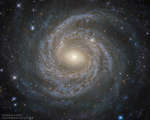 APOD: 2020 August 16 Б NGC 6814: Grand Design Spiral Galaxy from Hubble
16.08.2020
In the center of this serene stellar swirl is likely a harrowing black-hole beast. The surrounding swirl sweeps around billions of stars which are highlighted by the brightest and bluest. The breadth and beauty of the display give the swirl the designation of a grand design spiral galaxy.
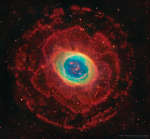 Rings Around the Ring Nebula
18.08.2021
The Ring Nebula (M57), is more complicated than it appears through a small telescope. The easily visible central ring is about one light-year across, but this remarkably deep exposure - a collaborative effort combining data from three different large telescopes - explores the looping filaments of glowing gas extending much farther from the nebula's central star.
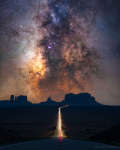 Road to the Galactic Center
25.10.2021
Does the road to our galaxy's center go through Monument Valley? It doesn't have to, but if your road does -- take a picture. In this case, the road is US Route 163 and iconic buttes on the Navajo National Reservation populate the horizon.
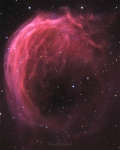 APOD: 2026 September 29 Б Sh2 188: The Shrimp Nebula
29.09.2026
What causes the swirl in the Shrimp Nebula? Its high speed is likely. What is sure is that Sh2-188 is one of the larger planetary nebulas on the night sky, by angular size, spanning about half the diameter of the Moon.
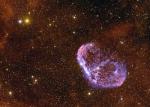 A Crescent Nebula Star Field
15.04.2003
What caused the Crescent Nebula? Looking like an emerging space cocoon, the Crescent Nebula, visible on the right, was created by the brightest star in its center. A leading progenitor hypothesis has the Crescent Nebula beginning to form about 250,000 years ago.
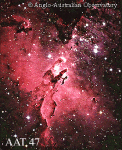 M16: Nebula With Star Cluster
18.01.1997
The photogenic M16 shown above is composed of a young star cluster associated with a spectacular emission nebulae lined with clouds of interstellar dust. The gorgeous spectacle lies toward the galactic center region, some 7,000 light years distant in the constellation Serpens.
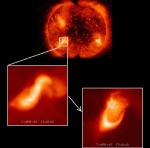 Sigmoids Predict Solar Eruptions
16.03.1999
On the Sun, S marks the spot. Solar explosions have been discovered to explode preferentially from regions marked with this letter. The surface of the quiet Sun is a maze of hot gas and flowing magnetic fields. When two regions of high magnetic field strength approach each other, they typically pass uneventfully.
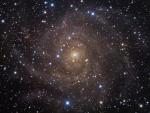 Hidden Galaxy IC 342
5.10.2006
Similar in size to other large, bright spiral galaxies IC 342 is a mere 7 million light-years distant in the long-necked, northern constellation Camelopardalis. A sprawling island universe, IC 342 would otherwise...
|
January February March April May June July August September October |
|||||||||||||||||||||||||||||||||||||||||||||||||