
|
You entered: gas
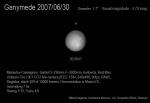 Astronomer s Moon
24.08.2007
Jupiter is an astronomer's planet -- its large size and contrasting global cloud belts and zones allow detailed studies with a range of earthbound telescopes. On the other hand, most telescopic views of Jupiter's moons usually show only featureless, tantalizing points of light hovering near the ruling gas giant.
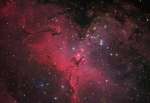 M16 and the Eagle Nebula
19.07.2008
Young star cluster M16 is surrounded by natal clouds of cosmic dust and glowing gas also known as The Eagle Nebula. This beautifully detailed image of the region includes fantastic shapes made famous in well-known Hubble Space Telescope close-ups of the starforming complex.
 NGC 7822 in Cepheus
28.08.2009
Pillars of gas, dust, and young, hot stars fill the center of NGC 7822. At the edge of a giant molecular cloud toward the northern constellation Cepheus, the glowing star forming region lies about 3,000 light-years away. Within the nebula, bright edges and tantalizing shapes are highlighted in this colorful skyscape.
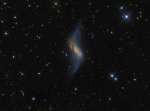 Polar Ring Galaxy NGC 660
21.01.2011
NGC 660 lies near the center of this intriguing skyscape, swimming in the boundaries of the constellation Pisces. Over 20 million light-years away, its peculiar appearance marks it as a polar ring galaxy.
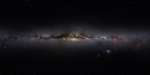 A Journey Through the Night Sky
20.05.2011
Majestic nebulae and stars of our Milky Way Galaxy stretch across this panoramic image of the entire night sky. At full resolution, the 5 gigapixel mosaic was stitched together from over 37,000 images...
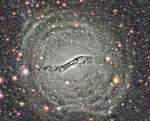 The Outer Shells of Centaurus A
1.07.2012
What causes the surrounding shells in peculiar galaxy Cen A? In 2002 a fascinating image of peculiar galaxy Centaurus A was released, processed to highlight a faint blue arc indicating an ongoing collision with a smaller galaxy.
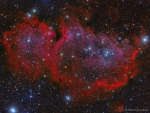 IC 1848: The Soul Nebula
27.02.2016
Stars are forming in the Soul of the Queen of Aethopia. More specifically, a large star forming region called the Soul Nebula can be found in the direction of the constellation Cassiopeia, who Greek mythology credits as the vain wife of a King who long ago ruled lands surrounding the upper Nile river.
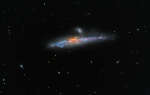 NGC 4631: The Whale Galaxy
2.06.2016
NGC 4631 is a big beautiful spiral galaxy. Seen edge-on, it lies only 25 million light-years away in the well-trained northern constellation Canes Venatici. The galaxy's slightly distorted wedge shape suggests to some a cosmic herring and to others its popular moniker, The Whale Galaxy.
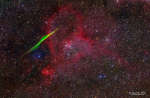 Spiral Meteor through the Heart Nebula
4.09.2016
What is this meteor doing? Dynamically, the unusually short and asymmetric train may indicate that the sand-sized grain at the center of the glow is momentarily spinning as it ablates, causing its path to be slightly spiral.
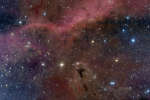 Dark Nebula LDN 1622 and Barnards Loop
5.04.2017
The silhouette of an intriguing dark nebula inhabits this cosmic scene. Lynds' Dark Nebula (LDN) 1622 appears below center against a faint background of glowing hydrogen gas only easily seen in long telescopic exposures of the region.
|
January February March April May June July August September October |
|||||||||||||||||||||||||||||||||||||||||||||||||