
|
You entered: gas
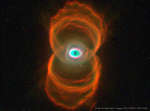 MyCn18: An Hourglass Planetary Nebula
10.05.2015
The sands of time are running out for the central star of this hourglass-shaped planetary nebula. With its nuclear fuel exhausted, this brief, spectacular, closing phase of a Sun-like star's life occurs as its outer layers are ejected - its core becoming a cooling, fading white dwarf.
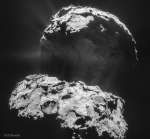 Comet 67P from Spacecraft Rosetta
2.02.2016
Spacecraft Rosetta continues to circle and map Comet Churyumov-Gerasimenko. Crossing the inner Solar System for ten years to reach the vicinity of the comet in 2014, the robotic spacecraft continues to image the unusual double-lobed comet nucleus. The featured image, taken one year ago, shows dust and gas escaping from the comet's nucleus.
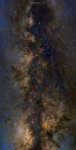 Great Rift Near the Center of the Milky Way
10.11.2016
Over 100 telescopic image panels in this stunning vertical mosaic span about 50 degrees across the night sky. They follow part of the Great Rift, the dark river of dust and molecular gas that stretches along the plane of our Milky Way Galaxy.
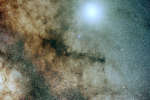 The Planet and the Pipe
7.06.2019
Now posing against our galaxy's rich starfields and nebulae, brilliant planet Jupiter shines in the night sky. Its almost overwhelming glow is near the top of the frame in this colorful telephoto portrait of the central Milky Way.
 South of Carina
22.05.2020
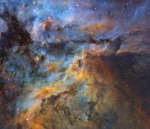
With natal dust clouds in silhouette against glowing atomic gas, this colorful and chaotic vista lies within one of the largest star forming regions in the Milky Way galaxy, the Great Carina Nebula.
 A Falcon 9 Nebula
4.09.2021
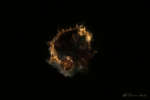
Not the Hubble Space Telescope's latest view of a distant galactic nebula, this illuminated cloud of gas and dust dazzled early morning spacecoast skygazers on August 29. The snapshot was taken at 3:17am from Space View Park in Titusville, Florida.
 IC 2574: Coddington's Nebula
6.02.2025
Grand spiral galaxies often seem to get all the glory, flaunting their young, bright, blue star clusters in beautiful, symmetric spiral arms. But small, irregular galaxies form stars too. In fact dwarf galaxy IC 2574 shows clear evidence of intense star forming activity in its telltale reddish regions of glowing hydrogen gas.
 Infrared Helix
1.09.1997
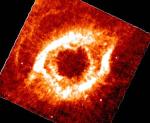
Five hundred light years from Earth, in the constellation Aquarius, a sun-like star is dying. Its last few thousand years have produced the Helix, a well studied and nearby example of a Planetary Nebula - typical of this final phase of stellar evolution.
 Neptune and Triton from Palomar
20.10.2003
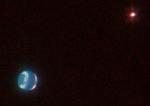
How's the weather on Neptune? Tracking major weather patterns on the Solar System's outermost gas giant can help in the understanding of global weather patterns here on Earth. Each summer for the past five years, Neptune has been imaged and major weather patterns studied.
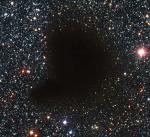 Molecular Cloud Barnard 68
11.05.1999
Where did all the stars go? What used to be considered a hole in the sky is now known to astronomers as a dark molecular cloud. Here, a high concentration of dust and molecular gas absorb practically all the visible light emitted from background stars.
|
January February March April May June July August September October |
|||||||||||||||||||||||||||||||||||||||||||||||||