
|
You entered: gas
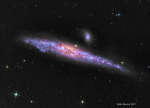 NGC 4631: The Whale Galaxy
6.10.2022
NGC 4631 is a big beautiful spiral galaxy. Seen edge-on, it lies only 25 million light-years away in the well-trained northern constellation Canes Venatici. The galaxy's slightly distorted wedge shape suggests to some a cosmic herring and to others its popular moniker, The Whale Galaxy.
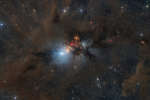 NGC 1333: Stellar Nursery in Perseus
30.01.2026
NGC 1333 is seen in visible light as a reflection nebula, dominated by bluish hues characteristic of starlight reflected by interstellar dust. A mere 1,000 light-years distant toward the heroic constellation Perseus, it lies at the edge of a large, star-forming molecular cloud.
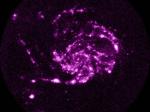 M101: An Ultraviolet View
10.06.2000
This picture of giant spiral galaxy Messier 101 (M101) was taken by the Ultraviolet Imaging Telescope (UIT). UIT flew into orbit as part of the Astro 2 mission on-board the Space Shuttle Endeavour in March 1995.
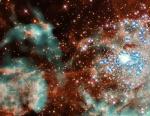 Star Cluster R136 Bursts Out
30.07.2001
In the center of star-forming region 30 Doradus lies a huge cluster of the largest, hottest, most massive stars known. Known as R136, the cluster's energetic stars are breaking out of the cocoon of gas and dust from which they formed.
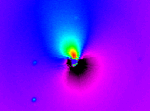 A Dust Jet From Hale-Bopp
29.07.1996
Approaching the inner Solar System, comet Hale-Bopp's icy nucleus is heated by sunlight, accelerating its production of dust and gas. Shrouded in the resulting cloud, known as the coma, the cometary nucleus remains hidden from direct view.
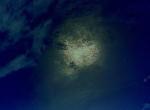 Spiral Eddies On Planet Earth
20.10.1997
Can you identify this stellar nebula? How many light-years from Earth did you say? Looking like a twisting cloud of gas and dust between the stars this wispy nebulosity is actually close by - a spiral eddy formed near the North Atlantic Gulf Stream off the East coast of the US.
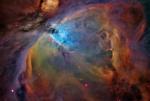 An Orion of a Different Color
25.03.2004
Look up into the sky tonight, and even with a good telescope you won't come across a sight quite like this one. It is a familiar object though, the grand stellar nursery known as the Orion Nebula.
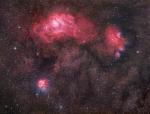 Sagittarius Triplet
9.09.2004
These three bright nebulae are often featured in telescopic tours of the constellation Sagittarius and the view toward the center of our Milky Way galaxy. In fact, 18th century cosmic tourist Charles Messier cataloged two of them; M8, the nebula above and left of center, and colorful M20 at the lower left.
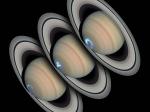 Persistent Saturnian Auroras
22.02.2005
Are Saturn's auroras like Earth's? To help answer this question, the Hubble Space Telescope and the Cassini spacecraft monitored Saturn's South Pole simultaneously as Cassini closed in on the gas giant in January 2004. Hubble snapped images in ultraviolet light, while Cassini recorded radio emissions and monitored the solar wind.
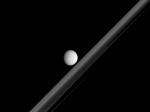 Saturnian Moon and Rings
18.04.2005
When can a robot produce art? When it glides past the rings of Saturn, for one. As the robot spacecraft Cassini orbiting Saturn crossed outside the famous photogenic ring plane of the expansive planet, the rings were imaged from the outside, nearly edge on, and in the shadow of Saturn.
|
January February March April May June July August September October |
|||||||||||||||||||||||||||||||||||||||||||||||||