
|
You entered: gas
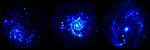 A Spiral Galaxy Gallery
14.03.1998
A progression of beautiful spiral galaxies is illustrated above with three photographs from NASA's Ultraviolet Imaging Telescope (UIT). Flying above the Earth's obscuring layer of atmosphere on the Space Shuttle Columbia during...
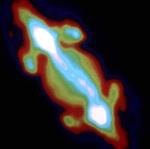 Radio Jupiter
9.10.2003
This view of gas giant Jupiter, made from data recorded at the Very Large Array radio observatory near Socorro, New Mexico, may not look too familiar. In fact, there is no sign of a bright, round planet striped with cloud bands, sporting a Great Red Spot.
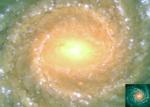 Spiral Galaxy NGC 1232
30.09.1998
Galaxies are fascinating not only for what is visible, but for what is invisible. Grand spiral galaxy NGC 1232, recently captured in detail by the new Very Large Telescope, is a good example.
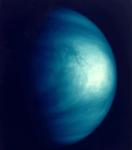 Venus: Just Passing By
12.06.1999
Venus, the second closest planet to the Sun, is a popular way-point for spacecraft headed for the gas giant planets in the outer reaches of the solar system. Why visit Venus first? Using...
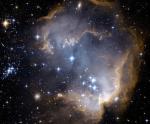 NGC 602 and Beyond
10.01.2007
Near the outskirts of the Small Magellanic Cloud, a satellite galaxy some 200 thousand light-years distant, lies 5 million year young star cluster NGC 602. Surrounded by natal gas and dust, NGC 602 is featured in this stunning Hubble image of the region.
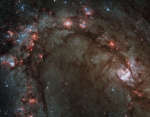 M83s Center from Refurbished Hubble
16.11.2009
What's happening at the center of spiral galaxy M83? Just about everything, from the looks of it. M83 is one of the closest spiral galaxies to our own Milky Way Galaxy and from a distance of 15 million light-years, appears to be relatively normal.
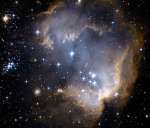 NGC 602 and Beyond
3.04.2010
Near the outskirts of the Small Magellanic Cloud, a satellite galaxy some 200 thousand light-years distant, lies 5 million year young star cluster NGC 602. Surrounded by natal gas and dust, NGC 602 is featured in this stunning Hubble image of the region.
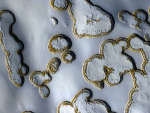 Dry Ice Pits on Mars
26.09.2011
Part of Mars is defrosting. Around the South Pole of Mars, toward the end of every Martian summer, the warm weather causes a section of the vast carbon-dioxide ice cap to evaporate. Pits begin to appear and expand where the carbon dioxide dry ice sublimates directly into gas.
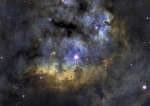 NGC 7822 in Cepheus
16.11.2011
Hot, young stars and cosmic pillars of gas and dust seem to crowd into NGC 7822. At the edge of a giant molecular cloud toward the northern constellation Cepheus, the glowing star forming region lies about 3,000 light-years away. Within the nebula, bright edges and dark shapes are highlighted in this colorful skyscape.
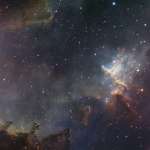 Melotte 15 in the Heart
9.11.2012
Cosmic clouds seem to form fantastic shapes in the central regions of emission nebula IC 1805. Of course, the clouds are sculpted by stellar winds and radiation from massive hot stars in the nebula's newborn star cluster, Melotte 15.
|
January February March April May June July August September October |
|||||||||||||||||||||||||||||||||||||||||||||||||