
|
You entered: star
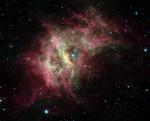 Cosmic Construction Zone RCW 49
3.06.2004
Stars and planets appear to be under construction in dusty nebula RCW 49. This Spitzer Space Telescope false-color infrared view of the nearby stellar nursery shows that known, hot stars are well on their way to clearing out the nebula's central regions.
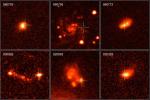 The Host Galaxies of Long Duration GRBs
17.05.2006
What causes the powerful explosions knows as gamma-ray bursts? Astrophysicists still aren't sure, but the longest duration gamma-ray bursts (GRBs) seem to involve very massive stars. A new clue indicating this was uncovered recently by a series of images taken by the orbiting Hubble Space Telescope.
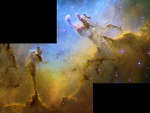 The Eagle Nebula in Hydrogen Oxygen, and Silicon
26.02.2008
Bright blue stars are still forming in the dark pillars of the Eagle Nebula. Made famous by a picture from the Hubble Space Telescope in 1995, the Eagle Nebula shows the dramatic process of star formation.
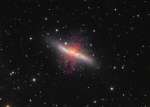 M82: Starburst Galaxy with a Superwind
6.10.2011
Also known as the Cigar Galaxy for its elongated visual appearance, M82 is a starburst galaxy with a superwind. In fact, through ensuing supernova explosions and powerful winds from massive stars, the burst of star formation in M82 is driving the prodigous outflow of material.
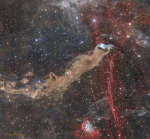 Wolfs Cave Nebula
14.11.2022
The mysterious blue reflection nebula found in catalogs as VdB 152 or Ced 201 really is very faint. It lies at the tip of the long dark nebula Barnard 175 in a dusty complex that has also been called Wolf's Cave.
 APOD: 2023 June 7 Б M94: A Double Ring Galaxy
6.06.2023
Most galaxies don't have any rings of stars and gas -- why does M94 have two? First, spiral galaxy M94 has an inner ring of newly formed stars surrounding its nucleus, giving it not only an unusual appearance but also a strong interior glow.
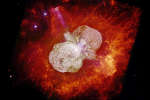 APOD: 2008 June 17- Eta Carinae and the Homunculus Nebula
17.06.2008
How did the star Eta Carinae create this unusual nebula? No one knows for sure. About 165 years ago, the southern star Eta Carinae mysteriously became the second brightest star in the night sky. In 20 years, after ejecting more mass than our Sun, Eta Car unexpected faded.
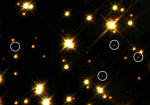 White Dwarfs Cool
10.09.1995
The circled stars in the above picture are from a class that is hard to see in the cosmos: white dwarfs. The entire photo covers a small region near the center of a globular cluster known as M4. Researchers using the Hubble Space Telescope discovered a large concentration of white dwarfs in M4.
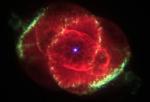 The Cat's Eye Nebula
2.08.1997
Three thousand light years away, a dying star throws off shells of glowing gas. This image from the Hubble Space Telescope reveals "The Cat's Eye Nebula" to be one of the most complex planetary nebulae known.
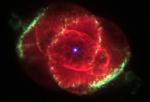 The Cat's Eye Nebula
31.10.1998
Three thousand light years away, a dying star throws off shells of glowing gas. This image from the Hubble Space Telescope reveals The Cat's Eye Nebula to be one of the most complex planetary nebulae known.
|
January February March April May June July August September October |
|||||||||||||||||||||||||||||||||||||||||||||||||