
|
You entered: star
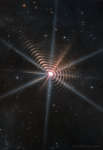 Dust Shells around WR 140 from Webb
13.10.2022
What are those strange rings? Rich in dust, the rings are likely 3D shells -- but how they were created remains a topic of research. Where they were created is well known: in a binary...
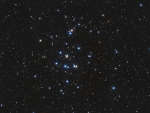 M44: The Beehive Cluster
22.02.2014
A mere 600 light-years away, M44 is one of the closest star clusters to our solar system. Also known as the Praesepe or the Beehive cluster its stars are young though, about 600 million years old compared to our Sun's 4.5 billion years.
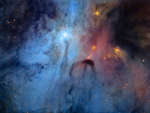 IC 4603: Reflection Nebula in Ophiuchius
23.07.2014
Why does this starfield photograph resemble an impressionistic painting? The effect is created not by digital trickery but by large amounts of interstellar dust. Dust, minute globs rich in carbon and similar in size to cigarette smoke, frequently starts in the outer atmospheres of large, cool, young stars.
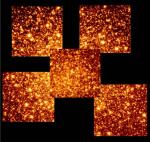 NGC 6712: Galactic Globular Cluster
25.02.1999
Following orbits which loop high above the galactic plane, globular star clusters are probably 12 to 14 billion years old - truly ancient denizens of our Milky Way Galaxy. After analyzing these new ESO/VLT images...
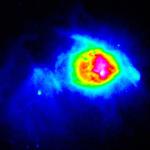 Hydrogen Blob N88A in the Small Magellanic Cloud
29.07.1999
The bright blob of hydrogen gas cataloged as N88A is seen at the right. It measures a mere 3 light years across. Emerging from the cool, dusty interstellar medium in a nearby irregular galaxy known as the Small Magellanic Cloud, N88A hides hot young stars at its core.
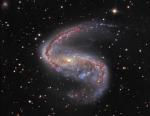 NGC 2442: Galaxy in Volans
15.03.2007
Distorted galaxy NGC 2442 can be found in the southern constellation of the flying fish, (Piscis) Volans. Located about 50 million light-years away, the galaxy's two spiral arms extending from a pronounced central bar give it an ominous hook-shaped appearance.
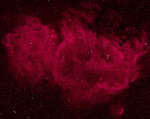 IC 1848: The Soul Nebula
15.04.2013
Stars are forming in the Soul of the Queen of Aethopia. More specifically, a large star forming region called the Soul Nebula can be found in the direction of the constellation Cassiopeia, who Greek mythology credits as the vain wife of a King who long ago ruled lands surrounding the upper Nile river.
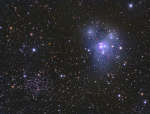 NGC 7129 and NGC 7142
30.08.2019
This wide-field telescopic image looks toward the constellation Cepheus and an intriguing visual pairing of dusty reflection nebula NGC 7129 (right) and open star cluster NGC 7142. The two appear separated by only half a degree on the sky, but they actually lie at quite different distances.
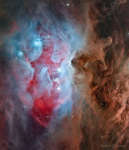 APOD: 2026 February 2 Б Orion: The Running Man Nebula
2.02.2026
What part of Orion is this? Just north of the famous Orion Nebula is a picturesque star forming region in Orion's Sword that contains a lot of intricate dust -- some of which appears blue because it reflects the light of bright embedded stars.
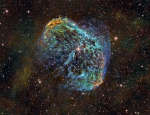 NGC 6888: The Crescent Nebula
16.08.2012
NGC 6888, also known as the Crescent Nebula, is a cosmic bubble about 25 light-years across, blown by winds from its central, bright, massive star. This colorful portrait of the nebula uses narrow band image data combined in the Hubble palatte.
|
January February March April May June July August September October |
|||||||||||||||||||||||||||||||||||||||||||||||||