
|
You entered: star
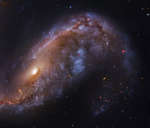 NGC 2442: Galaxy in Volans
17.08.2017
Distorted galaxy NGC 2442 can be found in the southern constellation of the flying fish, (Piscis) Volans. Located about 50 million light-years away, the galaxy's two spiral arms extending from a pronounced central bar have a hook-like appearance in wide-field images.
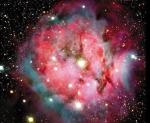 IC 5146: The Cocoon Nebula
14.10.2002
How did this nebula get created? The Cocoon Nebula, cataloged as IC 5146, is a strikingly beautiful nebula located about 4,000 light years away toward the constellation of Cygnus. Inside the Cocoon is a newly developing open cluster of stars.
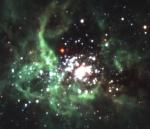 Tarantula
4.06.1997
NGC 2070 is an immense star forming region in a nearby galaxy known as the Large Magellanic Cloud. Its spidery appearance is responsible for its popular name, "The Tarantula Nebula", except that this tarantula is about 1,000 light-years across, and 165,000 light-years away in the southern constellation Dorado.
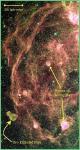 Stellar Laboratories in the LMC
25.07.1997
Stars are evolving in the Large Magellanic Clouds (LMC). This is particularly evident in the above close-up of the LMC's edge, which appears about as large as the full moon. Visible only...
 Andromedas Core
27.12.2004
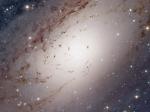
The center of the Andromeda galaxy is beautiful but strange. Andromeda, indexed as M31, is so close to our own Milky Way Galaxy that it gives a unique perspective into galaxy composition by allowing us to see into its core.
 Starburst Galaxy M94
26.05.2015
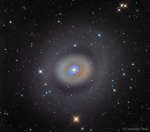
What could cause the center of M94 to be so bright? Spiral galaxy M94 has a ring of newly formed stars surrounding its nucleus, giving it not only an unusual appearance but also a strong interior glow.
 North Celestial Tree
28.07.2022
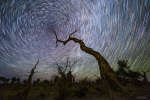
An ancient tree seems to reach out and touch Earth's North Celestial Pole in this well-planned night skyscape. Consecutive exposures for the timelapse composition were recorded with a camera fixed to a tripod in the Yiwu Desert Poplar Forests in northwest Xinjiang, China.
 HD 82943: Planet Swallower
18.05.2001
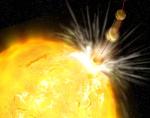
Stars like HD 82943 are main sequence G dwarf stars with temperatures and compositions similar to the Sun. Also like the Sun, HD 82943 is known to have at least two giant planets, but unlike gas giants in our solar system their orbits are not nearly circular and bring them closer to the parent star.
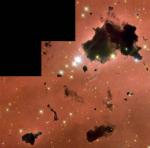 Thackeray's Globules
8.01.2002
Rich star fields and glowing hydrogen gas silhouette dense, opaque clouds of interstellar gas and dust in this Hubble Space Telescope close-up of IC 2944, a bright star forming region in Centaurus, 5,900 light-years away. The largest of these dark globules, first spotted by South African astronomer A. D.
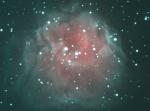 Sharpless 212 in Hydrogen and Sulfur
18.12.2001
Where do the most massive stars form? Observational evidence indicates that the outskirts of developing open clusters of stars are primary locations. Pictured above is one such open cluster: Sharpless 212. Visible in the image center are massive stars in the open cluster.
|
January February March April May June July August September October |
|||||||||||||||||||||||||||||||||||||||||||||||||