
|
You entered: dust
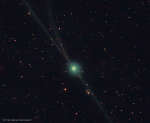 Almost Three Tails for Comet Encke
19.02.2017
How can a comet have three tails? Normally, a comet has two tails: an ion tail of charged particles emitted by the comet and pushed out by the wind from...
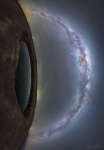 Eye on the Milky Way
20.04.2020
Have you ever had stars in your eyes? It appears that the eye on the left does, and moreover it appears to be gazing at even more stars. The featured 27-frame mosaic was taken last July from Ojas de Salar in the Atacama Desert of Chile.
 APOD: 2024 October 7 Б The Long Tails of Comet Tsuchinshan ATLAS
6.10.2024
A bright comet is moving into the evening skies. C/2023 A3 (TsuchinshanБATLAS) has brightened and even though it is now easily visible to the unaided eye, it is so near to the Sun that it is still difficult to see. Pictured, Comet TsuchinshanБATLAS was captured just before sunrise from an Andes Mountain in Peru.
 APOD: 2025 September 4 Б NGC 4565: Galaxy on Edge
3.09.2025
Magnificent spiral galaxy NGC 4565 is viewed edge-on from planet Earth. Also known as the Needle Galaxy for its narrow profile, bright NGC 4565 is a stop on many telescopic tours of the northern sky, in the faint but well-groomed constellation Coma Berenices.
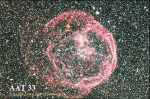 Henize 70: A SuperBubble In The LMC
10.05.1996
Massive stars (tens of times the mass of the Sun) profoundly affect their galactic environment. Churning and mixing the clouds of gas and dust between the stars, they leave their mark in the compositions and locations of future generations of stars and star systems.
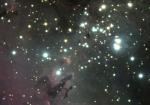 Blue Stars and Red Pillars
18.07.1997
Bright blue stars are still forming in the red pillars of the Eagle Nebula. Made famous by a picture from the Hubble Space Telescope in 1995, the Eagle Nebula shows the dramatic process of star formation. To the upper right of the nebula in the above picture lies the heart of the open cluster M16.
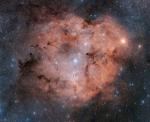 IC 1396 in Cepheus
8.09.2005
Stunning emission nebula IC 1396 mixes glowing cosmic gas and dark dust clouds in the high and far off constellation of Cepheus. As pictured here, the star forming region sprawls across hundreds of light-years -- spanning over three degrees on the sky while nearly 3,000 light-years from planet Earth.
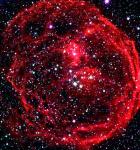 Henize 70: A Superbubble in the LMC
29.11.1999
Massive stars -- upwards of tens of times the mass of the Sun - profoundly affect their galactic environment. Churning and mixing the clouds of gas and dust between the stars, they leave their mark on the compositions and locations of future generations of stars and star systems.
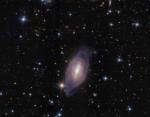 Polar Ring Galaxy NGC 2685
15.02.2007
NGC 2685 is a confirmed polar ring galaxy - a rare type of galaxy with stars, gas and dust orbiting in rings perpendicular to the plane of a flat galactic disk. The bizarre configuration could...
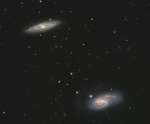 M65 and M66
15.06.2012
Nearby and bright, spiral galaxies M65 (top) and M66 stand out in this engaging cosmic snapshot. The pair are just 35 million light-years distant and around 100,000 light-years across, about the size of our own spiral Milky Way.
|
January February March April May June July August September October |
|||||||||||||||||||||||||||||||||||||||||||||||||