
|
You entered: dust
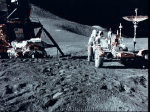 Apollo 15: Driving on the Moon
7.06.1997
Apollo 15 astronaut James Irwin works on the first Lunar Roving Vehicle, before he and fellow astronaut David Scott take it out for a drive. Sloping up behind the lunar module "Falcon" on the left are lunar mountains Hadley Delta and Apennine Front, while about 5 kilometers behind Irwin is St. George Crater.
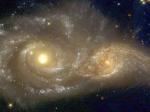 Spiral Galaxies in Collision
21.11.2004
Billions of years from now, only one of these two galaxies will remain. Until then, spiral galaxies NGC 2207 and IC 2163 will slowly pull each other apart, creating tides of matter, sheets of shocked gas, lanes of dark dust, bursts of star formation, and streams of cast-away stars.
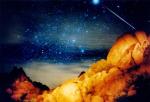 A Sirius Leonid Meteor
18.11.1999
In the sky or on the web, did you watch this year's Leonid meteor shower? If you did, meteors flashing through the night sky should be a familiar sight. Recorded last year during...
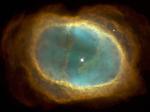 NGC 3132: The Eight Burst Nebula
14.10.2007
It's the dim star, not the bright one, near the center of NGC 3132 that created this odd but beautiful planetary nebula. Nicknamed the Eight-Burst Nebula and the Southern Ring Nebula, the glowing gas originated in the outer layers of a star like our Sun.
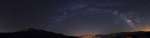 Alborz Mountain Milky Way
3.05.2008
Snow-capped stratovolcano Mt. Damavand climbs to 5,670 meters (18,598 feet) near the left edge in this panoramic view of the world at night. Pan to the right and your gaze will sweep across the arch of our Milky Way Galaxy above the Alborz Mountain Range bordering the Caspian Sea.
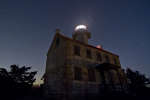 Lighthouse and Meteor
8.01.2012
Named for a forgotten constellation, the Quadrantid Meteor Shower is an annual event for planet Earth's northern hemisphere skygazers. It usually peaks briefly in the cold, early morning hours of January 4. The shower's radiant point on the sky lies within the old, astronomically obsolete constellation Quadrans Muralis.
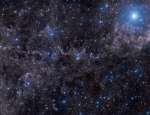 Stars in a Dusty Sky
28.09.2012
Bright star Markab anchors this dusty skyscape. At the top right corner of the frame, Markab itself marks a corner of an asterism known as the Great Square, found within the boundaries of the constellation Pegasus, the flying horse.
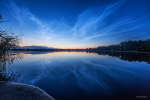 The Veins of Heaven
26.07.2019
Transfusing sunlight through a still dark sky, this exceptional display of noctilucent clouds was captured earlier this month, reflected in the calm waters of Vallentuna Lake near Stockholm, Sweden. From the edge of space...
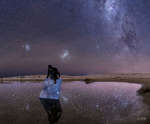 Night Sky Reflected
13.09.2021
What's that in the mirror? In the featured image of the dark southern sky, the three brightest galaxies of the night are all relatively easy to identify. Starting from the left, these are the Small Magellanic Cloud (SMC), the Large Magellanic Cloud (LMC), and part of the central band of our Milky Way Galaxy.
 APOD: 2025 August 29 Б A Dark Veil in Ophiuchus
29.08.2025
The diffuse hydrogen-alpha glow of emission region Sh2-27 fills this cosmic scene. The field of view spans nearly 3 degrees across the nebula-rich constellation Ophiuchus toward the central Milky Way. A Dark Veil...
|
January February March April May June July August September October |
|||||||||||||||||||||||||||||||||||||||||||||||||