
|
You entered: dust
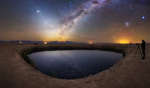 Laguna Starry Sky
27.01.2018
Staring toward the heavens, one of the many lagunas in the Atacama Desert salt flat calmly reflects a starry night sky near San Pedro de Atacama, Chile, planet Earth. Cosmic rifts of dust, star clouds, and nebulae of the central Milky Way galaxy are rising in the east, beyond a volcanic horizon.
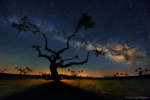 The Galaxy Tree
30.12.2018
First came the trees. In the town of Salamanca, Spain, the photographer noticed how distinctive a grove of oak trees looked after being pruned. Next came the galaxy. The photographer stayed up until 2 am, waiting until the Milky Way Galaxy rose above the level of a majestic looking oak.
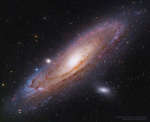 M31: The Andromeda Galaxy
19.01.2022
The most distant object easily visible to the unaided eye is M31, the great Andromeda Galaxy. Even at some two and a half million light-years distant, this immense spiral galaxy -- spanning over 200,000 light years -- is visible, although as a faint, nebulous cloud in the constellation Andromeda.
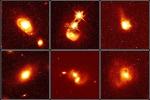 A Quasar Portrait Gallery
9.03.2002
Quasars (QUASi-stellAR objects) lie near the edge of the observable Universe. Discovered in 1963, astronomers were astounded that such objects could be visible across billions of light-years, as this implies they must emit prodigious amounts of energy. Where does the energy come from?
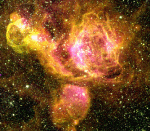 A Star Forming Region in the LMC
23.08.1997
Stars sometimes form in colorful ways. Pictured above is a small region in the nearby LMC galaxy where stars are forming. After a star is born, it may do several things to energize its immediate neighborhood.
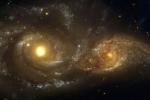 Spiral Galaxies in Collision
9.11.1999
Billions of years from now, only one of these two galaxies will remain. Until then, spiral galaxies NGC 2207 and IC 2163 will slowly pull each other apart, creating tides of matter, sheets of shocked gas, lanes of dark dust, bursts of star formation, and streams of cast-away stars.
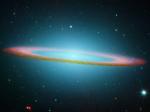 The Sombrero Galaxy in Infrared
11.05.2005
This floating ring is the size of a galaxy. In fact, it is part of the photogenic Sombrero Galaxy, one of the largest galaxies in the nearby Virgo Cluster of Galaxies. The dark band of dust that obscures the mid-section of the Sombrero Galaxy in optical light actually glows brightly in infrared light.
 Meteor by Moonlight
15.08.2009
Dark skies are favored for viewing meteor showers. But the annual Perseid Meteor Shower still entertained skygazers around the world this week even though the Moon brightened the night. At its last quarter phase...
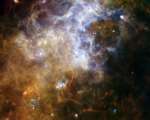 Herschel Views the Milky Way
2.09.2011
With a 3.5 meter diameter mirror, larger than the Hubble Space Telescope, ESA's Herschel Space Observatory explores the Universe at infrared wavelengths. Herschel is named for German-born British astronomer Frederick William Herschel who discovered infrared light over 200 years ago.
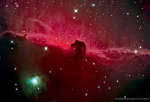 The Horsehead Nebula
31.12.2013
The Horsehead Nebula is one of the most famous nebulae on the sky. It is visible as the dark indentation to the red emission nebula in the center of the above photograph. The horse-head feature is dark because it is really an opaque dust cloud that lies in front of the bright red emission nebula.
|
January February March April May June July August September October |
|||||||||||||||||||||||||||||||||||||||||||||||||