
|
You entered: dust
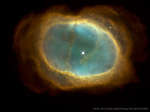 NGC 3132: The Eight Burst Nebula
7.06.2015
It's the dim star, not the bright one, near the center of NGC 3132 that created this odd but beautiful planetary nebula. Nicknamed the Eight-Burst Nebula and the Southern Ring Nebula, the glowing gas originated in the outer layers of a star like our Sun.
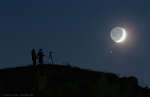 The Hill, The Moon, and Saturn
16.11.2018
Last Sunday when the Moon was young its sunlit crescent hung low near the western horizon at sunset. With strong earthshine it was joined by Saturn shining in the early evening sky for a beautiful conjunction visible to skygazers around our fair planet.
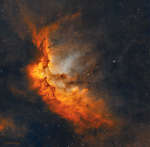 NGC 7380: The Wizard Nebula
14.11.2022
What powers are being wielded in the Wizard Nebula? Gravitation strong enough to form stars, and stellar winds and radiations powerful enough to create and dissolve towers of gas. Located only 8,000 light years away, the Wizard nebula, featured here, surrounds developing open star cluster NGC 7380.
 APOD: 2026 February 22 Б Shadow of a Martian Robot
22.02.2026
What if you saw your shadow on Mars and it wasn't human? Then you might be the Opportunity rover exploring Mars. Opportunity explored the Red Planet from 2004 to 2018, finding evidence of ancient water, and sending breathtaking images across the inner Solar System.
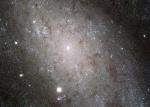 The Stars of NGC 300
20.08.2005
Like grains of sand on a cosmic beach, individual stars of large spiral galaxy NGC 300 are resolved in this sharp image from the Hubble Space Telescope's Advanced Camera for Surveys (ACS). The inner region of the galaxy is pictured, spanning about 7,500 light-years.
 The Antennae
30.06.2006
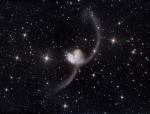
Some 60 million light-years away in the southerly constellation Corvus, two large galaxies have collided. But stars in the two galaxies - NGC 4038 and NGC 4039 - don't collide in the course of the ponderous, billion year or so long event.
 NGC 3521 Close Up
13.01.2011
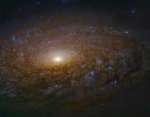
Gorgeous spiral galaxy NGC 3521 is a mere 35 million light-years distant, toward the constellation Leo. Spanning some 50,000 light-years, its central region is shown in this dramatic image, constructed from data drawn from the Hubble Legacy Archive.
 The Little Dipper
14.05.2011
At 2nd magnitude, Polaris is far from the brightest star in the night sky. But it is the brightest star at the left of this well-composed, starry mosaic spanning about 23 degrees across the northern sky asterism dubbed the Little Dipper.
 Jupiter and the Geminid
28.12.2023
For a brief moment, this brilliant fireball meteor outshone Jupiter in planet Earth's night. The serendipitous image was captured while hunting meteors under cold Canadian skies with a camera in timelapse mode on December 14, near the peak of the Geminid meteor shower.
 APOD: 2026 May 26 Б NGC 3660 and Burcins Galaxy
26.05.2026
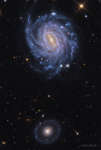
The upper galaxy might be more photogenic, but the lower galaxy is more unusual. The galaxy up top is NGC 3660, a spiral galaxy similar to our own Milky Way galaxy in that it has several bright blue spiral arms and a central bar of stars, dust, and gas.
|
January February March April May June July August September October |
|||||||||||||||||||||||||||||||||||||||||||||||||