
|
You entered: dust
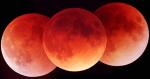 A Lunar Eclipse in Three Exposures
25.01.2000
Our Moon turned red last week. The reason was that during the night of January 20, a total lunar eclipse occurred. The above digitally superimposed photographs captured the Moon three times during this lunar...
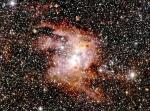 Giant Emission Nebula NGC 3603 in Infrared
14.08.2002
NGC 3603 is the largest region of glowing gas in our Milky Way galaxy. Spanning over 20 light years across, the giant emission nebula (HII region) is home to a massive star cluster, thick dust pillars, and a star about to explode.
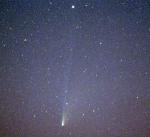 Bright Comet SOHO
21.05.1998
Discovered this month with an orbiting solar observatory, bright Comet SOHO has now emerged from the Sun's glare. This telephoto picture of the new naked-eye comet was taken by astrophotographer Michael Horn after sunset in the western twilight above Lake Samsonvale, Brisbane, Australia on May 18. The comet is seen in the constellation Orion.
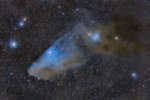 IC 4592: The Blue Horsehead Reflection Nebula
2.04.2013
Do you see the horse's head? What you are seeing is not the famous Horsehead nebula toward Orion but rather a fainter nebula that only takes on a familiar form with deeper imaging. The main part of the above imaged molecular cloud complex is a reflection nebula cataloged as IC 4592.
 APOD: 2023 October 30 Б Reflections of the Ghost Nebula
30.10.2023
Do any shapes seem to jump out at you from this interstellar field of stars and dust? The jeweled expanse, filled with faint, starlight-reflecting clouds, drifts through the night in the royal constellation of Cepheus.
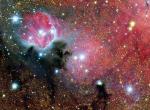 East of the Lagoon Nebula
20.05.2002
To the east of the Lagoon Nebula is a star field rich in diversity. On the lower left are clouds rich in dark dust that hide background stars and young star systems still forming. Dark clouds include LDN 227 on the left and IC 1275 on the right, with a bright star near its tip.
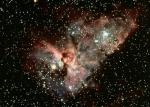 The Keyhole Nebula
12.01.1998
The dark dusty Keyhole Nebula gets its name from its unusual shape. Officially designated NGC 3324, the Keyhole Nebula is a smaller region superposed on the larger Eta Carina Nebula. These nebulae were created by the dying star Eta Carina, which is prone to violent outbursts during its final centuries.
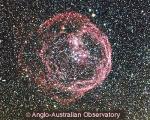 Henize 70: A SuperBubble In The LMC
13.06.1998
Stars with tens of times the mass of the Sun profoundly affect their galactic environment. Churning and mixing the interstellar gas and dust clouds they leave their mark in the compositions and locations of future generations of stars and star systems.
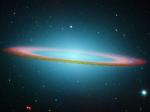 The Sombrero Galaxy in Infrared
21.01.2007
This floating ring is the size of a galaxy. In fact, it is part of the photogenic Sombrero Galaxy, one of the largest galaxies in the nearby Virgo Cluster of Galaxies. The dark band of dust that obscures the mid-section of the Sombrero Galaxy in optical light actually glows brightly in infrared light.
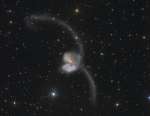 The Antennae
29.04.2011
Some 60 million light-years away in the southerly constellation Corvus, two large galaxies collided. But the stars in the two galaxies, cataloged as NGC 4038 and NGC 4039, don't collide in the course of the ponderous event, lasting hundreds of millions of years.
|
January February March April May June July August September October |
|||||||||||||||||||||||||||||||||||||||||||||||||