
|
You entered: dust
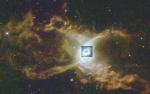 The Red Spider Planetary Nebula
6.01.1998
Oh what a tangled web a planetary nebula can weave. The Red Spider Planetary Nebula shows the complex structure that can result when a normal star ejects its outer gases and becomes a white dwarf star.
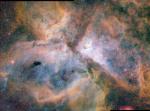 The Carina Nebula in Three Colors
17.07.2001
Stars, like people, do not always go gentle into that good night. The above Carina Nebula, also known as the Keyhole Nebula and NGC 3372, results from dying star Eta Carinae's violently casting off dust and gas during its final centuries.
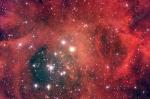 NGC 2244: A Star Cluster in the Rosette Nebula
22.08.2000
In the heart of the Rosette Nebula lies a bright open cluster of stars that lights up the nebula. The stars of NGC 2244 formed from the surrounding gas only four million years ago and emit light and wind that define the nebula's appearance today
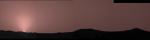 A Rusty Sunset on Mars
4.08.1997
On Mars, sunsets can appear salmon pink. The unusual color is partly due to rust: oxidized iron from Martian dust circulating in the Martian atmosphere. Clouds appear in the morning and evening, but usually evaporate in the midday Sun.
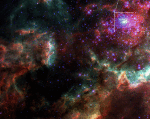 In the Center of 30 Doradus
21.02.1999
In the center of 30 Doradus lies a huge cluster of the largest, hottest, most massive stars known. The center of this cluster, known as R136, is boxed in the upper right portion of the above picture.
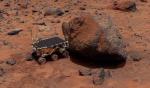 Mars Rocks, Sojourner Rolls
30.10.1999
This sharp color image featuring Mars rock Yogi and the rolling Sojourner robot shows off Yogi's two-toned surface. Yogi appears to be leaning into the prevailing winds causing some to suggest that its color contrast may be caused by the accumulation of rust colored dust on its windward face.
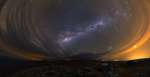 Atacama s Cloudy Night
27.07.2013
Storm clouds do sometimes come to Chile's Atacama desert, known as the driest place on Earth. These washed through the night sky just last month during the winter season, captured in this panoramic view.
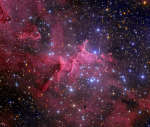 Melotte 15 in the Heart
27.12.2013
Cosmic clouds seem to form fantastic shapes in the central regions of emission nebula IC 1805. Of course, the clouds are sculpted by stellar winds and radiation from massive hot stars in the nebula's newborn star cluster, Melotte 15.
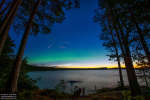 Perseid, Aurora, and Noctilucent Clouds
11.08.2016
Night skies over northern Sweden can hold some tantalizing sights in August. Gazing toward the Big Dipper, this beautiful northern skyscape captures three of them in a single frame taken last August 12/13. Though receding from northern skies for the season, night shining or noctilucent clouds are hanging just above the horizon.
 M100: A Grand Design Spiral Galaxy
25.12.2018
Majestic on a truly cosmic scale, M100 is appropriately known as a grand design spiral galaxy. It is a large galaxy of over 100 billion stars with well-defined spiral arms that is similar to our own Milky Way Galaxy.
|
January February March April May June July August September October |
|||||||||||||||||||||||||||||||||||||||||||||||||