
|
You entered: dust
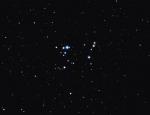 The 37 Cluster
18.11.2005
For the mostly harmless denizens of planet Earth, the brighter stars of open cluster NGC 2169 seem to form a cosmic 37. (Did you expect 42?.) Of course, the improbable numerical asterism appears solely by chance and lies at an estimated distance of 3,600 light-years toward the constellation Orion.
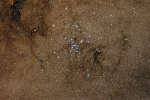 M7: Open Star Cluster in Scorpius
8.11.2009
M7 is one of the most prominent open clusters of stars on the sky. The cluster, dominated by bright blue stars, can be seen with the naked eye in a dark sky in the tail of the constellation of the Scorpion (Scorpius).
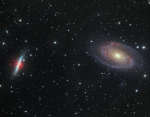 Galaxy Wars: M81 versus M82
24.03.2010
On the right, surrounded by blue spiral arms, is spiral galaxy M81. On the left, marked by red gas and dust clouds, is irregular galaxy M82. This stunning vista shows these two mammoth galaxies locked in gravitational combat, as they have been for the past billion years.
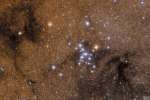 M7: Open Star Cluster in Scorpius
7.01.2014
M7 is one of the most prominent open clusters of stars on the sky. The cluster, dominated by bright blue stars, can be seen with the naked eye in a dark sky in the tail of the constellation of the Scorpion (Scorpius).
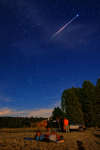 Perseid from Torralba del Burgo
13.08.2016
Perseid meteors rained on planet Earth last night. This year the stream of dust from periodic comet Swift-Tuttle has produced a stunningly active shower of bright cosmic streaks. In this 25 second long exposure...
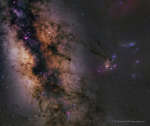 Saturn in the Milky Way
10.06.2017
Saturn is near opposition in planet Earth's sky. Rising at sunset and shining brightly throughout the night, it also lies near a line-of-sight to crowded starfields, nebulae, and obscuring dust clouds along the Milky Way.
 Shadow of a Martian Robot
17.02.2019
What if you saw your shadow on Mars and it wasn't human? Then you might be the Opportunity rover currently exploring Mars. Opportunity explored the red planet from 2004 to 2018, finding evidence of ancient water, and sending breathtaking images across the inner Solar System.
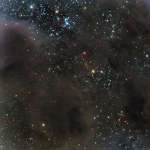 Chamaeleon II Dark Cloud
2.08.2019
A small constellation hiding near the south celestial pole, The Chamaeleon boasts no bright stars. Stars are forming within its constellation boundaries though, in a complex of dark, dusty molecular clouds. Some 500 light-years...
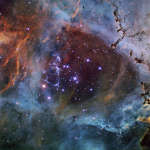 NGC 2244: A Star Cluster in the Rosette Nebula
21.02.2021
In the heart of the Rosette Nebula lies a bright open cluster of stars that lights up the nebula. The stars of NGC 2244 formed from the surrounding gas only a few million years ago.
 APOD: 2025 August 30 Б A Two Percent Moon
30.08.2025
A young crescent moon can be hard to see. That's because when the Moon shows it's crescent phase (young or old) it can never be far from the Sun in planet Earth's sky.
|
January February March April May June July August September October |
|||||||||||||||||||||||||||||||||||||||||||||||||