
|
You entered: dust
 Panorama of the Whale Galaxy
17.05.2010
The see the full length of this blue whale, scroll right. NGC 4631 is a big beautiful spiral galaxy seen edge-on at only about 30 million light-years away. This galaxy's slightly distorted wedge shape led to its popular moniker of the Whale galaxy.
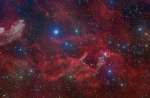 NGC 1788 and the Witch s Whiskers
19.04.2013
This skyscape finds an esthetic balance of interstellar dust and gas residing in the suburbs of the nebula rich constellation of Orion. Reflecting the light of bright star Rigel, Beta Orionis, the jutting, bluish chin of the Witch Head Nebula is at the upper left.
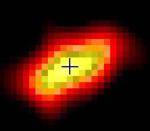 HR 4796A: A Recipe for Planets
22.04.1998
Two hundred and twenty light years from Earth, planets are forming. Recent observations of the binary star system HR 4796 have shown that one of the stars is surrounded by a dusty gaseous disk. This disk is of the right size, age, and density for dust pellets to accrete surrounding matter.
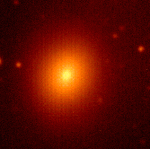 Dwarf Elliptical Galaxy M32
6.01.1996
Being the largest galaxy around can sometimes make you popular. Pictured is M31's companion galaxy M32. M31, the Andromeda galaxy, is the largest galaxy in our Local Group of galaxies - even our tremendous Milky Way Galaxy is smaller.
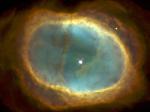 NGC 3132: The Eight Burst Nebula
6.02.2005
It's the dim star, not the bright one, near the center of NGC 3132 that created this odd but beautiful planetary nebula. Nicknamed the Eight-Burst Nebula and the Southern Ring Nebula, the glowing gas originated in the outer layers of a star like our Sun.
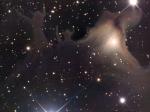 SH2 136: A Spooky Nebula
31.10.2006
The dark nebula SH2-136 appears to be celebrating Halloween all of the time. The complex process of star formation create dust clouds of many shapes and sizes -- it is human perception that might identify a ghoulish creature, on the right of the above image, chasing humans.
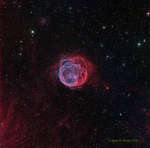 Henize 70: A Superbubble in the LMC
4.02.2019
Massive stars profoundly affect their galactic environments. Churning and mixing interstellar clouds of gas and dust, stars -- most notably those upwards of tens of times the mass of our Sun -- leave their mark on the compositions and locations of future generations of stars.
 The Veins of Heaven
19.06.2020
Transfusing sunlight through a darkened sky, this beautiful display of noctilucent clouds was captured earlier this week, reflected in calm waters from Nykobing Mors, Denmark. From the edge of space, about 80 kilometers above...
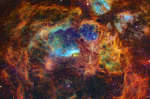 NGC 6357: The Lobster Nebula
28.10.2020
Why is the Lobster Nebula forming some of the most massive stars known? No one is yet sure. Cataloged as NGC 6357, the Lobster Nebula houses the open star cluster Pismis 24 near its center -- a home to unusually bright and massive stars.
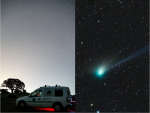 Naked Eye Comet ZTF
21.01.2023
Comet C/2022E3 (ZTF) is no longer too dim to require a telescope for viewing. By January 19, it could just be seen with the naked eye in this rural sky with little light pollution from a location about 20 kilometers from Salamanca, Spain.
|
January February March April May June July August September October |
|||||||||||||||||||||||||||||||||||||||||||||||||