
|
You entered: X-ray
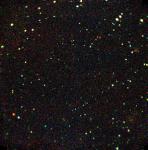 Chandra Deep Field
12.10.2002
Officially the Chandra Deep Field - South, this picture represents the deepest ever x-ray image of the Universe. One million seconds of accumulated exposure time with the orbiting Chandra X-ray Observatory went in to its making.
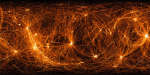 NICER at Night
1.06.2019
A payload on board the International Space Station, the Neutron star Interior Composition Explorer (NICER) twists and turns to track cosmic sources of X-rays as the station orbits planet Earth every 93 minutes. During orbit nighttime, its X-ray detectors remain on.
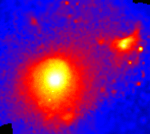 The Virgo Cluster: Hot Plasma and Dark Matter
19.04.1996
This ROSAT image of the Virgo cluster of galaxies reveals a hot X-ray emitting plasma or gas with a temperature of 10-100 million degrees pervading the cluster. False colors have been used to represent the intensity of X-ray emission.
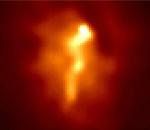 Abell 1795: A Galaxy Cluster s Cooling Flow
8.12.2000
Throughout the Universe, galaxies tend to swarm in groups ranging from just a handful of members to casts of thousands. Astronomers have realized since the early 1970s that the larger swarms, immense clusters of galaxies millions of light-years across, are immersed within tenuous clouds of hot gas which glow strongly in x-rays.
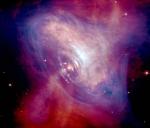 Composite Crab
4.09.2003
The Crab Pulsar, a city-sized, magnetized neutron star spinning 30 times a second, lies at the center of this composite image of the inner region of the well-known Crab Nebula. The spectacular picture combines...
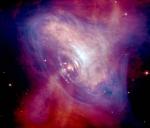 Composite Crab
26.03.2005
(xxxre linkxxx) The Crab Pulsar, a city-sized, magnetized neutron star spinning 30 times a second, lies at the center of this composite image of the inner region of the well-known Crab Nebula. The spectacular...
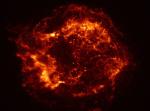 Chandras First Light: Cassiopeia A
27.08.1999
Cosmic wreckage from the detonation of a massive star is the subject of this official first image from NASA's Chandra X-ray Observatory. The supernova remnant, known as Cassiopeia A, was produced when a star exploded around 300 years ago in this northern sky constellation.
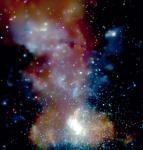 Galactic Center Star Clusters
10.08.2006
If you had x-ray vision, the central regions of our Galaxy would not be hidden from view by cosmic dust clouds. Instead, the Milky Way toward Sagittarius might look something like this. Pleasing...
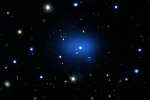 JKCS041: The Farthest Galaxy Cluster Yet Measured
28.10.2009
What if we could see back to the beginning of the universe? We can -- since it takes the age of the universe for light to cross the universe. Peering at distant objects, therefore, tells us about how the universe used to be, even near its beginning.
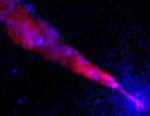 The Energetic Jet from Centaurus A
1.05.2003
The center of well-studied active galaxy Centaurus A is hidden from the view of optical telescopes by a cosmic jumble of stars, gas, and dust. But both radio and x-ray telescopes can trace the remarkable jet of high-energy particles streaming from the galaxy's core.
|
January February March April May June July August September October |
|||||||||||||||||||||||||||||||||||||||||||||||||