
|
You entered: X-ray
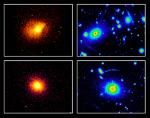 The Matter of Galaxy Clusters
24.10.2001
Situated over 2,000,000,000 (two billion) light-years from Earth, galaxies in cluster Abell 2390 (top) and MS2137.3-2353 (bottom) are seen in the right hand panels above, false-color images from the Hubble Space Telescope. Corresponding panels on the left reveal each cluster's x-ray appearance in images from the Chandra X-ray Observatory.
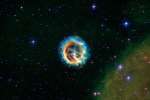 Supernova Remnant E0102 72
5.09.2009
The expanding debris cloud from the explosion of a massive star is captured in this multiwavelength composite, combining x-ray and optical images from the Chandra and Hubble telescopes. Identified as E0102-72, the supernova remnant lies about 190,000 light-years away in our neighboring galaxy, the Small Magellanic Cloud.
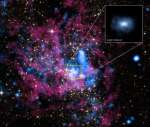 The Quiet Sagittarius A
6.09.2013
Hot gas is hard to swallow. At least that seems to be true for the supermassive black hole at the center of our Milky Way Galaxy. Known as source Sagittarius A*, the Milky Way's black hole is centered in this infrared (red and yellow hues) and X-ray (blue) composite.
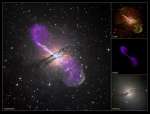 Active Galaxy Centaurus A
9.01.2008
A mere 11 million light-years away, Centaurus A is a giant elliptical galaxy - the closest active galaxy to Earth. This remarkable composite view of the galaxy combines image data from the x-ray ( Chandra), optical(ESO), and radio(VLA) regimes.
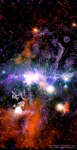 The Galactic Center in Stars, Gas, and Magnetism
1.06.2021
What's going on near the center of our galaxy? To help find out, a newly detailed panorama has been composed that explores regions just above and below the galactic plane in radio and X-ray light.
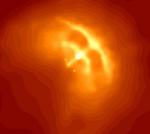 Vela Pulsar: Neutron Star-Ring-Jet
9.06.2000
This stunning image from the orbiting Chandra X-ray Observatory is centered on the Vela pulsar -- the collapsed stellar core within the Vela supernova remnant some 800 light-years distant. The Vela pulsar is a neutron star. More massive than the Sun, it has the
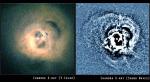 A Note on the Perseus Cluster
12.09.2003
A truly enormous collection of thousands of galaxies, the Perseus Cluster - like other large galaxy clusters - is filled with hot, x-ray emitting gas. The x-ray hot gas (not the individual galaxies) appears in the left panel above, a false color image from the Chandra Observatory.
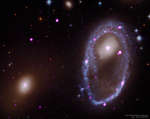 Cosmic Collision Forges Galactic Ring
16.09.2018
How could a galaxy become shaped like a ring? The rim of the blue galaxy pictured on the right is an immense ring-like structure 150,000 light years in diameter composed of newly formed, extremely bright, massive stars.
 Recycling Cassiopeia A
5.09.2019
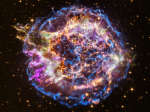
Massive stars in our Milky Way Galaxy live spectacular lives. Collapsing from vast cosmic clouds, their nuclear furnaces ignite and create heavy elements in their cores. After a few million years, the enriched material is blasted back into interstellar space where star formation can begin anew.
 Recycling Cassiopeia A
22.01.2021
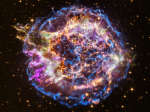
Massive stars in our Milky Way Galaxy live spectacular lives. Collapsing from vast cosmic clouds, their nuclear furnaces ignite and create heavy elements in their cores. After a few million years, the enriched material is blasted back into interstellar space where star formation can begin anew.
|
January February March April May June July August September October |
|||||||||||||||||||||||||||||||||||||||||||||||||