
|
You entered: background
 Dark Sky, Bright Sun
14.02.1999
In low Earth orbit there is not enough atmosphere to diffuse and scatter sunlight, so shadows are black and the sky is dark - even when the Sun shines. The harsh lighting produced this dramatic...
 Cosmic Ripples Implicate Dark Universe
29.05.2002
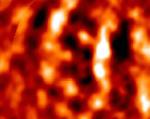
What may appear fuzzy to some makes things crystal clear to others. The cosmic microwave background radiation emanating from the universe could only have the above fuzzy pattern if it contained clear amounts of dark matter and dark energy.
 Dark Sky, Bright Sun
2.09.1997
In low Earth orbit there is not enough atmosphere to diffuse and scatter sunlight, so shadows are black and the sky is dark - even when the Sun shines. The harsh lighting produced this dramatic...
 Aurora in Red and Yellow
10.04.2000
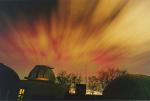
The past week brought some spectacular aurora to northern skies. These aurorae were caused by a large interplanetary shock wave that exploded from the Sun on April 4. When the shock wave reached the Earth on April 6, the resulting aurora could be seen in clear skies as far south as North Carolina.
 Colorful Moon Mosaic
7.09.2006
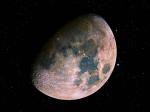
No single exposure can easily capture faint stars along with the subtle colors of the Moon. But this dramatic composite view highlights both. The mosaic digitally stitches together fifteen carefully exposed high resolution images of a bright, gibbous Moon and a representative background star field.
 Star Clouds Toward the Southern Crown
2.10.2002
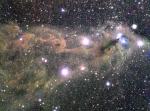
The flowing trails of dust toward Corona Australis, the constellation of the Southern Crown, are visible here because not because they glow, but because they absorb and reflect. The dust appears bluer when seen near bright stars because it preferentially reflects blue light.
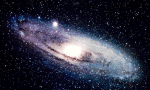 M31: The Andromeda Galaxy
1.11.1997
Andromeda is the nearest major galaxy to our own Milky Way Galaxy. Our Galaxy is thought to look much like Andromeda. Together these two galaxies dominate the Local Group of galaxies. The diffuse light from Andromeda is caused by the hundreds of billions of stars that compose it.
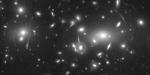 Abell 2218: A Galaxy Cluster Lens
11.01.1998
Gravity can bend light. Almost all of the bright objects in this Hubble Space Telescope image are galaxies in the cluster known as Abell 2218. The cluster is so massive and so compact that its gravity bends and focuses the light from galaxies that lie behind it.
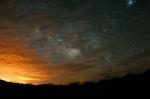 Star Clouds over Arizona
24.04.2006
The clouds in the foreground are much different than the clouds in the background. In the foreground are a photogenic deck of Earth-based water clouds. The long exposure used to create the above photograph makes the light from the left, reflected from Phoenix, Arizona, USA, appear like a sunset.
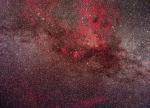 The Gum Nebula Supernova Remnant
7.11.2000
Because the Gum Nebula is the closest supernova remnant, it is actually hard to see. Spanning 40 degrees across the sky, the nebula is so large and faint it is easily lost in the din of a bright and complex background.
|
January February March April May June July August September |
|||||||||||||||||||||||||||||||||||||||||||||||||