
|
You entered: background
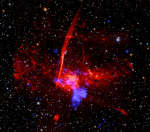 APOD: 2026 June 18 Б Possible Supernova Remnant in Galactic Center
18.06.2026
Do you see that blue blob to the lower right of the image center? Astronomers think that it shows where a massive star exploded as a supernova whose light reached Earth 1,700 years ago.
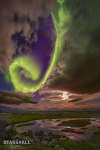 Spiral Aurora over Icelandic Divide
21.04.2019
Admire the beauty but fear the beast. The beauty is the aurora overhead, here taking the form of great green spiral, seen between picturesque clouds with the bright Moon to the side and stars in the background. The beast is the wave of charged particles that creates the aurora but might, one day, impair civilization.
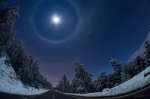 A Quadruple Lunar Halo Over Spain
3.12.2012
Sometimes falling ice crystals make the atmosphere into a giant lens causing arcs and halos to appear around the Sun or Moon. This past Saturday night was just such a time near Madrid, Spain, where a winter sky displayed not only a bright Moon but as many as four rare lunar halos.
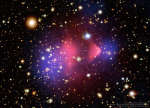 Sonified: The Matter of the Bullet Cluster
16.12.2020
What's the matter with the Bullet Cluster? This massive cluster of galaxies (1E 0657-558) creates gravitational lens distortions of background galaxies in a way that has been interpreted as strong evidence for the leading theory: that dark matter exists within.
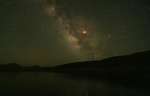 A Total Lunar Eclipse Over Tajikistan
7.11.2022
If the full Moon suddenly faded, what would you see? The answer was recorded in a dramatic time lapse video taken during the total lunar eclipse in 2011 from Tajikistan. During a total lunar eclipse, the Earth moves between the Moon and the Sun, causing the moon to fade dramatically.
 M51: Tidal Streams and H-alpha Ciffs
13.12.2024
An intriguing pair of interacting galaxies, M51 is the 51st entry in Charles Messier's famous catalog. Perhaps the original spiral nebula, the large galaxy with whirlpool-like spiral structure seen nearly face-on is also cataloged as NGC 5194. Its spiral arms and dust lanes sweep in front of its smaller companion galaxy, NGC 5195.
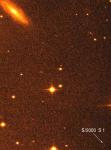 New Moons For Saturn
3.11.2000
Which planet has the most moons? For now, it's Saturn. Four newly discovered satellites bring the ringed planet's total to twenty-two, just edging out Uranus' twenty-one for the most known moons in the solar system. Of course, the newfound Saturnian satellites are not large and photogenic.
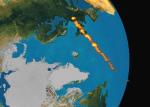 A Cosmic Snowball
30.05.1997
Like cosmic snowballs, fluffy comet-like objects the size of houses and composed mostly of water-ice, may be pummeling planet Earth 5 to 30 times a minute. This controversial theory was originally proposed in 1986 by Dr. Louis Frank (U. Iowa) based on data from NASA's Dynamics Explorer 1.
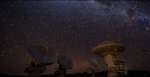 An ALMA Telescope Array Time Lapse
26.05.2014
It is the most expensive and complex ground-based astronomy project ever -- what will it see tonight? The Atacama Large Millimeter Array (ALMA) project consists of 66 dishes, many the size of a small house, situated in the high altitude Atacama Desert in Northern Chile.
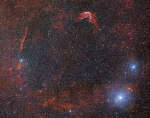 RCW 86: Historical Supernova Remnant
3.03.2023
In 185 AD, Chinese astronomers recorded the appearance of a new star in the Nanmen asterism. That part of the sky is identified with Alpha and Beta Centauri on modern star charts. The new star was visible to the naked-eye for months, and is now thought to be the earliest recorded supernova.
|
January February March April May June July August September |
|||||||||||||||||||||||||||||||||||||||||||||||||