
|
You entered: background
 Views from Cassini at Saturn
17.06.2017
What has the Cassini orbiter seen at Saturn? The featured music video shows some of the early highlights. In the first time-lapse sequence (00:07), a vertical line appears that is really Saturn's thin rings seen nearly edge-on. Soon some of Saturn's moon shoot past.
 Here Comes Comet Hyakutake
12.03.1996
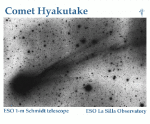
The reaction of ancient peoples to the appearance of bright comets has toppled empires, de-throned kings, and been taken as a sign of great things to come. Probably some of these comets did not get as bright as Comet Hyakutake ("hyah-koo-tah-kay") will in the next two weeks.
 The Swift View of Comet Lulin
20.02.2009
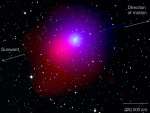
Now growing brighter, Comet Lulin is headed for its closest approach to planet Earth early next week. But the comet's greenish glow, familiar to earthbound skygazers, is replaced by false colors in this premier view from the orbiting Swift satellite.
 Quadruple Lunar Halo Over Winter Road
1.01.2022
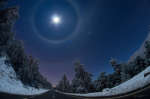
Sometimes falling ice crystals make the atmosphere into a giant lens causing arcs and halos to appear around the Sun or Moon. One Saturday night in 2012 was just such a time near Madrid, Spain, where a winter sky displayed not only a bright Moon but four rare lunar halos.
 Earth Nears Asteroid Toutatis
19.01.1997
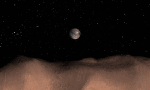
On November 29, 1996 the Earth came within 3.3 million miles of the asteroid Toutatis. Above is a computer simulated picture of this spectacle from the surface of Toutatis (a 2.5 degree field of view looking toward Earth). In Earth's sky, Toutatis appeared only as a faint object moving against a background of stars.
 The Matter of the Bullet Cluster
24.08.2006
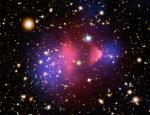
The matter in galaxy cluster 1E 0657-56, fondly known as the "bullet cluster", is shown in this composite image. A mere 3.4 billion light-years away, the bullet cluster's individual galaxies are seen...
 The Matter of the Bullet Cluster
23.08.2008
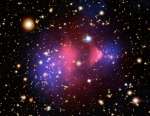
The matter in galaxy cluster 1E 0657-56, fondly known as the "bullet cluster", is shown in this composite image. A mere 3.4 billion light-years away, the bullet cluster's individual galaxies are seen...
 Centaurus Radio Jets Rising
13.04.2011
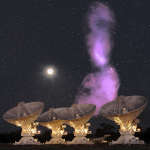
What if you could see the huge radio jets of Centaurus A rising? The Cen A radio jets are not only over a million light years long, they occupy an angular area over 200 times greater than the full Moon in Earth's sky.
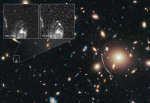 Galaxy Cluster Magnifies Distant Supernova
5.05.2014
How do you calibrate a huge gravitational lens? In this case the lens is the galaxy cluster Abell 383, a massive conglomeration of galaxies, hot gas, and dark matter that lies about 2.5 billion light years away (redshift z=0.187).
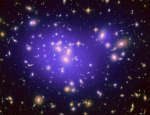 Galaxy Cluster Abell 1689 Magnifies the Dark Universe
24.08.2010
What's the matter with this cluster of galaxies? To find out what forms matter takes in the Abell 1689 cluster requires not only deep images from telescopes like the Hubble Space Telescope, but detailed computer modeling as well. To start, almost every fuzzy yellow patch in the above image is an entire galaxy.
|
January February March April May June July August September |
|||||||||||||||||||||||||||||||||||||||||||||||||