
|
You entered: background
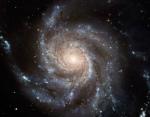 Messier 101
2.03.2006
Big, beautiful spiral galaxy M101 is one of the last entries in Charles Messier's famous catalog, but definitely not one of the least. About 170,000 light-years across, this galaxy is enormous, almost twice the size of our own Milky Way galaxy.
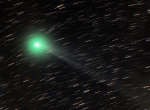 Comet Lemmon near the South Celestial Pole
7.02.2013
Currently sweeping through southern skies, Comet Lemmon (C/2012 F6) was named for its discovery last year as part of the Mount Lemmon (Arizona) Survey. Brighter than expected but still just below naked-eye visibility, Comet Lemmon sports a stunning lime green coma and faint divided tail in this telescopic image from February 4.
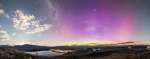 Aurora over New Zealand
26.02.2014
Sometimes the more you look at an image, the more you see. Such may be the case for this beautiful nighttime panorama taken last week in New Zealand. Visible right off, on the far left, are common clouds, slightly altered by the digital fusion of combining 11 separate 20-second exposures.
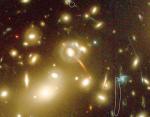 Galaxy Cluster Lenses Farthest Known Galaxy
17.02.2004
Gravity can bend light, allowing whole clusters of galaxies to act as huge telescopes. Almost all of the bright objects in this just-released Hubble Space Telescope image are galaxies in the cluster known as Abell 2218.
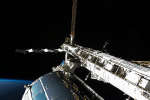 International Space Station: Find the Astronaut
2.12.2008
Where's the astronaut? Somewhere in this impressive array of International Space Station (ISS) hardware, astronaut Steve Bowen can be found upgrading and cleaning key parts of Earth's most prominent orbital outpost. Astronaut...
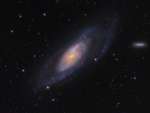 Messier 106
29.05.2009
Close to the Great Bear (Ursa Major) and surrounded by the stars of the Hunting Dogs (Canes Venatici), this celestial wonder was discovered in 1781 by the metric French astronomer Pierre Mechain. Later, it was added to the catalog of his friend and colleague Charles Messier as M106.
 Geostationary Highway
20.02.2010
Put a satellite in a circular orbit about 42,000 kilometers from the center of the Earth (36,000 kilometers or so above the surface) and it will orbit once in 24 hours. Because that matches Earth's rotation period, it is known as a geosynchronous orbit.
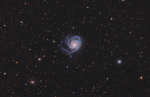 A View Toward M101
15.03.2019
Big, beautiful spiral galaxy M101 is one of the last entries in Charles Messier's famous catalog, but definitely not one of the least. About 170,000 light-years across, this galaxy is enormous, almost twice the size of our own Milky Way galaxy.
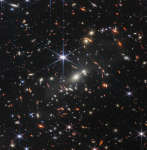 Webb s First Deep Field
13.07.2022
This is the deepest, sharpest infrared image of the cosmos so far. The view of the early Universe toward the southern constellation Volans was achieved in 12.5 hours of exposure with the NIRCam instrument on the James Webb Space Telescope. Of course the stars with six visible spikes are well within our own Milky Way.
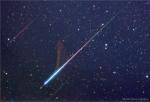 Fireball, Smoke Trail, Meteor Storm
22.11.2001
Returning from orbit, space shuttles enter the atmosphere at about 8 kilometers per second as friction heats their protective ceramic tiles to over 1,400 degrees Celsius. By contrast, the bits of comet dust...
|
January February March April May June July August September |
|||||||||||||||||||||||||||||||||||||||||||||||||