
|
You entered: surface
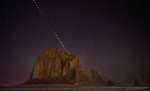 APOD: 2026 March 5 Б Total Lunar Eclipse over Tse Bitai
5.03.2026
Earlier this week, EarthБs shadow swept across the full Moon in the yearБs only total lunar eclipse. This stunning sequence combines images showing the MoonБs path across the night sky. Each lunar image captures our planetБs shadow gradually engulfing the Moon, culminating in its red glow.
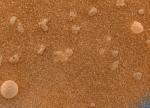 Magnified Mars
6.02.2004
At first glance, this sharp, color close-up gives the strong impression of pebbles strewn over a sandy beach. But the picture is one of the first microscopic images of another planet, captured by the Opportunity rover on its tenth sol on the martian surface at Meridiani Planum.
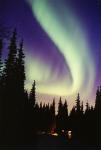 An Aurora Before the Storm
19.05.2000
Early April brought some of the most intense auroral storms this decade. An aurora on April 6 was reported to be the largest visible on Earth since 1989, and was seen throughout Europe and much of northern North America.
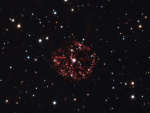 GK Per: Nova of 1901
5.11.2011
Early in the 20th century, GK Persei briefly became one of the brightest stars in planet Earth's sky, an event known as Nova Persei 1901. Documented in this modern day composite of two images from 2003 and 2011 the ejecta from the explosion, popularly called the Firework Nebula, continues to expand into space.
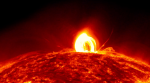 Coronal Rain on the Sun
26.02.2013
Does it rain on the Sun? Yes, although what falls is not water but extremely hot plasma. An example occurred in mid-July 2012 after an eruption on the Sun that produced both a Coronal Mass Ejection and a moderate solar flare. What was more unusual, however, was what happened next.
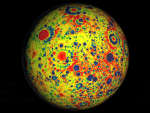 GRAIL Maps the Moons Gravity
19.03.2013
How did the Moon form? To help find out, NASA launched the twin Gravity Recovery and Interior Laboratory (GRAIL) satellites in 2011 to orbit and map the Moon's surface gravity in unprecedented detail.
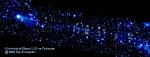 Comet 57P Falls to Pieces
2.08.2002
Comet 57P has fallen to pieces, at least 19 of them. Orbiting the Sun every 5.9 years or so this faint comet - also christened Comet 57P/du Toit-Neujmin-Delporte for its three 1941 co-discoverers - is simply...
 APOD: 2024 July 24 Б Exaggerated Moon
24.07.2024
Our Moon doesn't really have craters this big. Earth's Moon, Luna, also doesn't naturally show this spikey texture, and its colors are more subtle. But this digital creation is based on reality.
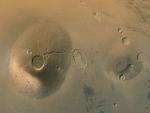 Ancient Volcanos of Mars
8.08.2002
Findings of ancient martian microbial fossils in meteorites and liquid water related features on Mars' surface are currently controversial issues. But one thing long established by space-based observations of the Red Planet is the presence of volcanos, as Mars supports some of the largest volcanos in the solar system.
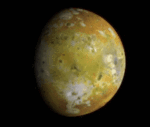 Galileo's First Color Image of Io
19.07.1996
Above is the first color image of Jupiter's volcanic moon Io released by the Galileo Project. (Io sounds like "eye-oh".) The image was made on June 25 when the Galileo spacecraft approached within 1.4 million miles.
|
January February March April May June July August September October |
|||||||||||||||||||||||||||||||||||||||||||||||||