
|
You entered: surface
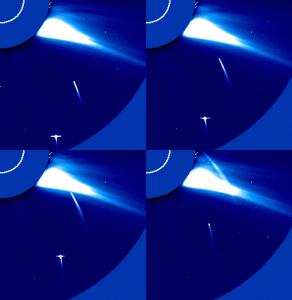 SOHOs Twin Sungrazers
11.06.1998
This four frame animation (courtesy D. Biesecker) shows two comets arcing toward a fatal fiery encounter with the Sun. These discovery images were recorded by the LASCO instrument on board the space-based SOHO solar observatory on June 1-2.
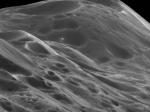 4000 Kilometers Above Saturns Iapetus
19.09.2007
What does the surface of Saturn's mysterious moon Iapetus look like? To help find out, the robotic Cassini spacecraft now orbiting Saturn was sent soaring last week just 2,000 kilometers from the unique equatorial ridge of the unusual walnut-shaped two-toned moon.
 The Shadow of Ingenuity s Damaged Rotor Blade
10.02.2024
On January 18, 2024, during its 72nd flight in the thin Martian atmosphere, autonomous Mars Helicopter Ingenuity rose to an altitude of 12 meters (40 feet) and hovered for 4.5 seconds above the Red Planet. Ingenuity's 72nd landing was a rough one though.
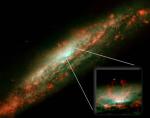 The Bubbling Cauldron of NGC 3079
22.08.2001
Edge-on spiral galaxy NGC 3079 is a mere 50 million light-years away toward the constellation Ursa Major. Shown in this stunning false-color Hubble Space Telescope image, the galaxy's disk - composed of spectacular star clusters in winding spiral arms and dramatic dark lanes of dust - spans some 70,000 light-years.
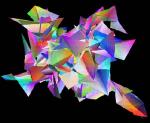 Quantum Gravity Claimed Detected on Earth
22.01.2002
Does gravity come in chucks? A theory known as Quantum Mechanics tells us about how the universe works on the smallest scales, while Einstein's General Theory of Relativity tells us about how gravity and the universe works on the largest scales. So far, no complete theory has been able to encompass them both.
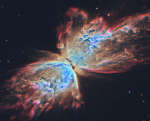 The Butterfly Nebula from Hubble
1.10.2014
The bright clusters and nebulae of planet Earth's night sky are often named for flowers or insects. Though its wingspan covers over 3 light-years, NGC 6302 is no exception. With an estimated surface...
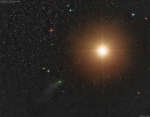 Comet Siding Spring Passes Mars
20.10.2014
Yesterday, a comet passed very close to Mars. In fact, Comet C/2013 A1 (Siding Spring) passed closer to the red planet than any comet has ever passed to Earth in recorded history. To take...
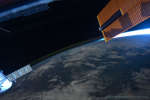 A Perseid Below
8.08.2021
Earthlings typically watch meteor showers by looking up. But this remarkable view, captured on August 13, 2011 by astronaut Ron Garan, caught a Perseid meteor by looking down. From Garan's perspective onboard...
 Earthset from Orion
20.11.2024
Eight billion people are about to disappear in this snapshot from space taken on 2022 November 21. On the sixth day of the Artemis I mission, their home world is setting behind the Moon's bright edge as viewed by an external camera on the outbound Orion spacecraft.
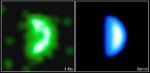 Venusian Half Shell
11.12.2001
Venus, second planet from the Sun, appears above imaged for the first time ever in x-rays (left) by the orbiting Chandra Observatory. Chandra's smoothed, false-color, x-ray view is compared to an optical image (right) from a small earthbound telescope.
|
January February March April May June July August September October |
|||||||||||||||||||||||||||||||||||||||||||||||||