
|
You entered: planet
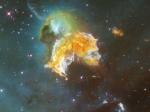 Rampaging Supernova Remnant N63A
8.06.2005
What has this supernova left behind? As little as 2,000 years ago, light from a massive stellar explosion in the Large Magellanic Clouds (LMC) first reached planet Earth. The LMC is a close...
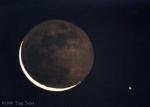 Mercury And The Moon
10.11.1999
Mercury is the closest planet to the Sun and never moves far from our parent star in Earth's sky. Racing around its tight orbit, this well-done world is a little over 1/3 the diameter of Earth and is often lost to our view in the solar glare.
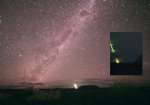 Fireball at Ayers Rock
28.06.2008
A weekend trip for astrophotography in central Australia can result in gorgeous skyscapes. In this example recorded in March of 2006, the center of our Milky Way Galaxy rises over planet Earth's horizon and the large sandstone formation called Uluru, also known as Ayers Rock.
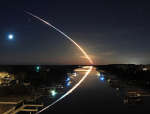 Waterway to Orbit
12.02.2010
The 32nd shuttle mission to the International Space Station, STS-130, left planet Earth on February 8. Its early morning launch to orbit from Kennedy Space Center's pad 39A followed the long, graceful, eastward arc seen in this 2 minute time exposure.
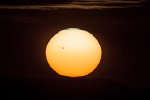 Sunspot at Sunset
8.01.2014
Sunsets may be the most watched celestial event, but lately sunsets have even offered something extra. A sunspot so large it was visible to the naked eye is captured in Swiss skies in this...
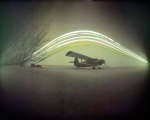 45 Days in the Sun
20.02.2015
From January 11 to February 25 2013, a pinhole camera sat in a field near Budapest, Hungary, planet Earth to create this intriguing solargraph. And for 45 days, an old Antonov An-2 biplane stood still while the Sun rose and set.
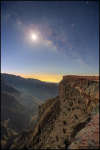 Milky Way in Moonlight
22.04.2016
A waning crescent moon, early morning twilight, and Al Hamra's city lights on the horizon can't hide the central Milky Way in this skyscape from planet Earth. Captured in a single exposure...
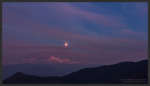 Moonrise Eclipse
1.02.2018
This atmospheric picture of a distant horizon looks toward the tall Trisul peaks of India's snowy Himalayan mountains. Taken from a remote location on January 31, brightest star Sirius shines at the upper right. The red Moon rising is gliding through Earth's shadow during the evening's much anticipated total lunar eclipse.
 Messier 4
28.11.2024
Messier 4 can be found west of bright red-giant star Antares, alpha star of the constellation Scorpius. M4 itself is only just visible from dark sky locations, even though the globular cluster of 100,000 stars or so is a mere 5,500 light-years away.
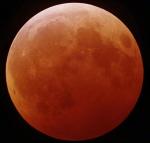 2001: A Total Lunar Eclipse
17.01.2001
The first and only total lunar eclipse for the year 2001 occured on the evening of January 9/10 as the full Moon glided through Earth's shadow. Unlike a total solar eclipse, a total lunar eclipse is visible for anyone on the night side of the planet during the event.
|
January February March April May June July August September October |
|||||||||||||||||||||||||||||||||||||||||||||||||