
|
You entered: planet
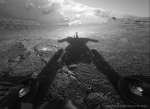 Shadow of a Martian Robot
16.02.2019
What if you saw your shadow on Mars and it wasn't human? Then you might be the Opportunity rover currently exploring Mars. Opportunity explored the red planet from 2004 to 2018, finding evidence of ancient water, and sending breathtaking images across the inner Solar System.
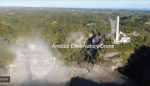 Arecibo Telescope Collapse
8.12.2020
This was one great scientific instrument. Starting in 1963, the 305-meters across Arecibo Telescope in Puerto Rico USA reigned as the largest single-dish radio telescope in the world for over 50 years. Among numerous...
 Betelgeuse Eclipsed
14.12.2023
Asteroid 319 Leona cast a shadow across planet Earth on December 12, as it passed in front of bright star Betelgeuse. But to see everyone's favorite red giant star fade this time...
 APOD: 2025 August 30 Б A Two Percent Moon
29.08.2025
A young crescent moon can be hard to see. That's because when the Moon shows it's crescent phase (young or old) it can never be far from the Sun in planet Earth's sky.
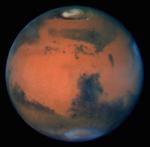 The Weather on Mars
23.03.1997
Would Mars be a nice place to visit? Sometimes. Much of Mars undergoes severe changes in climate during its orbit around the Sun, ranging from extreme cold to temperatures enjoyable by humans. But Mars...
 Isaac Newton Explains the Solar System
6.09.1997
Sir Isaac Newton changed the world. Born in 1643, Newton was only an above-average student. But he went home from Cambridge one summer in 1665, thought a lot about the physical nature of the world, and came back two years later with a revolutionary understanding of mathematics, gravitation, and optics.
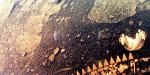 A Venus Landing
29.11.2003
This image is part of the first color panoramic view from Venus. A TV camera on the Soviet Venera 13 lander that parachuted to the surface on 1982 March 1 transmitted it. Venus' clouds...
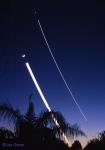 Venus Falls Out of the Evening Sky
3.09.1999
Orbiting closer to the Sun than planet Earth, bright Venus always appears to be near the Sun's position in our sky and often shines near the horizon in twilight hours. In fact, after...
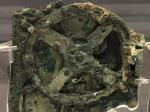 The Antikythera Mechanism
4.12.2006
What is it? It was found at the bottom of the sea aboard an ancient Greek ship. Its seeming complexity has prompted decades of study, although many of its functions remained unknown. Recent X-rays of the device have now confirmed the nature of the Antikythera mechanism, and discovered several surprising functions.
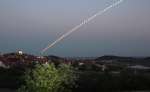 Hungarian Spring Eclipse
4.05.2013
Last week, as the Sun set a Full Moon rose over the springtime landscape of Tihany, Hungary on the northern shores of Lake Balaton. As it climbed into the clear sky, the Moon just grazed the dark, umbral shadow of planet Earth in the year's first partial lunar eclipse.
|
January February March April May June July August September October |
|||||||||||||||||||||||||||||||||||||||||||||||||