
|
You entered: rings
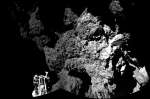 Welcome to a Comet
13.11.2014
The Rosetta Mission lander is safely on a comet. One of Philae's feet appears at the bottom left of this spectacular image of the surface of C67/P Churyumov-Gerasimenko. Still a happy lander, Philae...
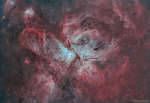 The Great Nebula in Carina
7.05.2019
What's happening in the center of the Carina Nebula? Stars are forming, dying, and leaving an impressive tapestry of dark dusty filaments. The entire Carina Nebula, cataloged as NGC 3372, spans over 300 light years and lies about 8,500 light-years away in the constellation of Carina.
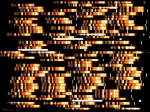 Breaking Distant Light
20.09.2020
In the distant universe, time appears to run slowly. Since time-dilated light appears shifted toward the red end of the spectrum (redshifted), astronomers are able to use cosmological time-slowing to help measure vast distances in the universe.
 APOD: 2024 March 24 Б Looking Back at an Eclipsed Earth
24.03.2024
Here is what the Earth looks like during a solar eclipse. The shadow of the Moon can be seen darkening part of Earth. This shadow moved across the Earth at nearly 2000 kilometers per hour.
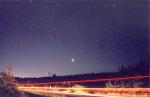 A July Dawn
7.08.2001
Those up before dawn in late July in the northern hemisphere could see planets, stars, and a spacecraft in a single quick glance before starting their day. Near the eastern horizon was bright Jupiter, and not far above and to its right was the very bright Venus.
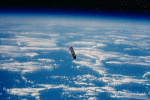 Tanks for the Lift
24.02.1996
Sixteen minutes after the liftoff of STS-29, the Space Shuttle Discovery's jettisoned External Tank (ET) is seen here, in a photograph by shuttle astronaut James P. Bagian, falling back towards Earth. The 154 foot long ET is the largest non-reusable component in the Shuttle system.
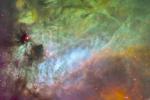 Elements of the Swan Nebula
11.08.2003
In the depths of the dark clouds of dust and molecular gas known as M17, stars continue to form. Also known as the Omega Nebula and Horseshoe Nebula, the darkness of M17's molecular clouds results from background starlight being absorbed by thick filaments of carbon-based smoke-sized dust.
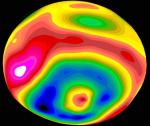 A Map of Asteroid Vesta
8.09.1997
Vesta is a huge rock 500 kilometers across that orbits out past Mars. Last week, the above map of Vesta created using the Hubble Space Telescope was released showing a rugged surface highlighted by a single crater spanning nearly the entire length of the asteroid.
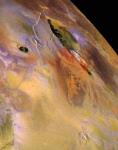 Zal Patera on Jupiter's Moon Io
7.03.2000
The Galileo orbiter's flyby of Io last November captured an unusual part of Jupiter's volcanic moon. From 26,000 kilometers away, Zal Patera was found to be a cauldron of flowing lava, gaseous vents, and tremendous peaks.
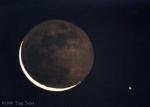 Mercury And The Moon
11.11.1999
Mercury is the closest planet to the Sun and never moves far from our parent star in Earth's sky. Racing around its tight orbit, this well-done world is a little over 1/3 the diameter of Earth and is often lost to our view in the solar glare.
|
January February March April May June July August September October |
|||||||||||||||||||||||||||||||||||||||||||||||||