
|
You entered: rings
 NGC 2244: A Star Cluster in the Rosette Nebula
17.03.2002
In the heart of the Rosette Nebula lies a bright open cluster of stars that lights up the nebula. The stars of NGC 2244 formed from the surrounding gas only four million years ago and emit light and wind that define the nebula's appearance today.
 Dusting Spiral Galaxies
16.01.1998
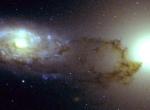
How much dust is in spiral galaxies? Does it block out much of the starlight? Because astronomers rely on an accurate knowledge of galaxy properties to investigate a wide range of problems, like galaxy and quasar evolution and the nature of dark matter, answers to simple questions like this are key.
 Attacking Mars
19.07.2004
The Spirit rover attacked Mars again late last month. What might look, above, like a military attack, though, was once again just a scientific one - Spirit was instructed to closely inspect some interesting rocks near Columbia Hills.
 Moon Occults Saturn
8.05.1999
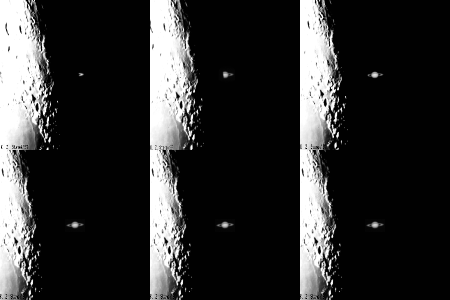
On September 18, 1997, many stargazers in the U. S. were able to watch a lovely early morning lunar occultation as a bright Moon passed in front of Saturn. Using a 1.2 meter reflector, astronomer Kris Stanek had an excellent view of this dream-like event from the Whipple Observatory atop Arizona's Mount Hopkins.
 Galaxy Wars: M81 versus M82
24.03.2010
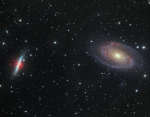
On the right, surrounded by blue spiral arms, is spiral galaxy M81. On the left, marked by red gas and dust clouds, is irregular galaxy M82. This stunning vista shows these two mammoth galaxies locked in gravitational combat, as they have been for the past billion years.
 Anticrepuscular Rays Over Wyoming
21.02.2012
What's happening over the horizon? Although the scene may appear somehow supernatural, nothing more unusual is occurring than a setting Sun and some well placed clouds. Pictured above are anticrepuscular rays. To understand them, start by picturing common crepuscular rays that are seen any time that sunlight pours though scattered clouds.
 Curiosity s View
8.08.2015
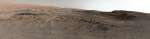
By planet Earth's calendar, the Curiosity Mars Rover reached its 3rd anniversary on the surface of the Red Planet on August 6. To celebrate, gaze across this dramatic panoramic view of diverse terrain typical of the rover's journey to the layered slopes of Aeolis Mons, also known as Mount Sharp.
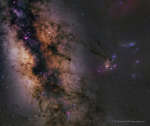 Saturn in the Milky Way
10.06.2017
Saturn is near opposition in planet Earth's sky. Rising at sunset and shining brightly throughout the night, it also lies near a line-of-sight to crowded starfields, nebulae, and obscuring dust clouds along the Milky Way.
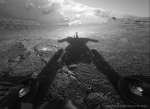 Shadow of a Martian Robot
17.02.2019
What if you saw your shadow on Mars and it wasn't human? Then you might be the Opportunity rover currently exploring Mars. Opportunity explored the red planet from 2004 to 2018, finding evidence of ancient water, and sending breathtaking images across the inner Solar System.
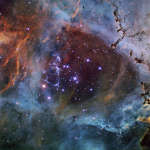 NGC 2244: A Star Cluster in the Rosette Nebula
21.02.2021
In the heart of the Rosette Nebula lies a bright open cluster of stars that lights up the nebula. The stars of NGC 2244 formed from the surrounding gas only a few million years ago.
|
January February March April May June July August September October |
|||||||||||||||||||||||||||||||||||||||||||||||||