
|
You entered: clouds
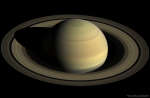 Saturn from Above
25.09.2016
This image of Saturn could not have been taken from Earth. No Earth based picture could possibly view the night side of Saturn and the corresponding shadow cast across Saturn's rings. Since Earth is much closer to the Sun than Saturn, only the day side of the ringed planet is visible from the Earth.
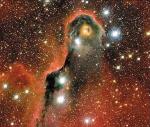 An Unusual Globule in IC 1396
25.03.2002
Is there a monster in IC 1396? Known to some as the Elephant's Trunk Nebula, parts of gas and dust clouds of this star formation region may appear to take on foreboding forms, some nearly human. The only real monster here, however, is a bright young star too far from Earth to hurt us.
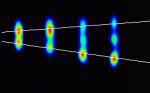 Micro-Quasar GRS1915 Puffs
2.12.1997
On the far side of our Galaxy, gas clouds explode away from a small black hole. This might seem peculiar, as black holes are supposed to attract matter. But material falling toward a black hole collides and heats up, creating an environment similar to a quasar that is far from stable.
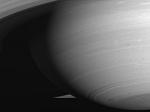 The Swirling Storms of Saturn
10.10.2005
Storms larger than hurricanes continually dot the upper atmosphere of the planet Saturn. A view of many storms occurring simultaneously was captured in July by the robot Cassini spacecraft now orbiting Saturn. An image of unusually high detail was made possible at that time when Cassini isolated a very specific color of polarized infrared light.
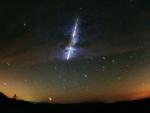 1998 Leonid Fireball
12.11.1999
Will this be the year? Last year's Leonid meteor shower did not produce the meteor storm many had hoped for. Still, it put on a dazzling show with many bright fireball meteors. For example, this Leonid fireball, photographed through light clouds, eerily flashed across the skies of Monteromano, Italy on November 17, 1998.
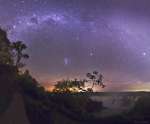 Iguacu Starry Night
14.05.2010
The arc of the southern Milky Way shone brightly on this starry night. Captured on May 4, in the foreground of this gorgeous skyview is the rainforest near the spectacular Iguaçu Falls and national park at the border of Brazil and Argentina.
 Globular Star Cluster 47 Tuc
16.01.2011
Globular star cluster 47 Tucanae is a jewel of the southern sky. Also known as NGC 104, it roams the halo of our Milky Way Galaxy along with some 200 other globular star clusters.
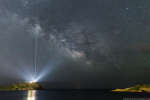 The Milky Way over the Temple of Poseidon
8.06.2015
What's that glowing in the distance? Although it may look like a lighthouse, the rays of light near the horizon actually emanate from the Temple of Poseidon at Cape Sounion, Greece. Some temple lights are even reflected in the Aegean Sea in the foreground.
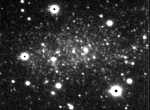 The Closest Galaxy: The Sagittarius Dwarf
4.02.1996
What's the closest galaxy to our Milky Way? For many years astronomers thought it was the Large Magellanic Cloud (LMC). But the seemingly insignificant fuzzy patch shown above turned out to be part of a galaxy that is even closer.
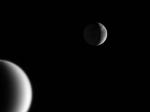 Crescents of Titan and Dione
29.03.2005
What would it be like to see a sky with many moons? Such is the sky above Saturn. When appearing close to each other, moons will show a similar phase. A view with...
|
January February March April May June July August September October |
|||||||||||||||||||||||||||||||||||||||||||||||||