
|
You entered: clouds
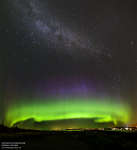 An Aurora Cupcake with a Milky Way Topping
9.09.2014
This sky looked delicious. Double auroral ovals were captured above the town lights of жstersund, Sweden, last week. Pictured above, the green ovals occurred lower to the ground than violet aurora rays above, making the whole display look a bit like a cupcake.
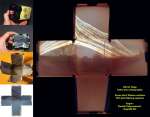 Sostice to Equinox Cubed
26.03.2016
This 3 month long exposure packed the days from December 22, 2015 through March 20 into a box. Dubbed a solargraph, the unconventional, unfolded picture was recorded with a pinhole camera made from a cube-shaped container, its sides lined with photographic paper.
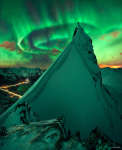 APOD: 2026 February 10 Б In Green Company: Aurora over Norway
10.02.2026
Raise your arms if you see an aurora. With those instructions, two nights went by with, well, clouds -- mostly. On the third night of returning to same peaks, though, the sky not only cleared up but lit up with a spectacular auroral display.
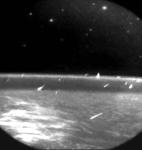 Leonids from Orbit
29.11.2000
Here is what a meteor shower looks like from orbit. During the peak of the 1997 Leonid Meteor Shower, the MSX satellite imaged from above 29 meteors over a 48 minute period entering the Earth's atmosphere. From above, meteors create short bright streaks.
 The Sky in Motion
31.12.2008
Still need to come up with a good new year's resolution? Consider one appropriate for 2009, the International Year of Astronomy; just look up -- experience, learn, and enjoy the changing sky. This 4-minute, time-lapse video is composed from a series of 7,000 images highlighting much of what you could see.
 Milky Way and Stone Tree
29.04.2013
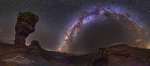
What's that next to the Milky Way? An unusual natural rock formation known as Roque Cinchado or Stone Tree found on the Spanish Canary Island of Tenerife. A famous icon, Roque Cinchado is likely a dense plug of cooled volcanic magma that remains after softer surrounding rock eroded away.
 Messier 77
10.05.2013
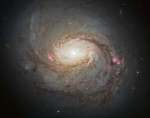
Face-on spiral galaxy M77 lies a mere 47 million light-years away toward the aquatic constellation Cetus. At that estimated distance, the gorgeous island universe is about 100 thousand light-years across. Also known...
 Young Stars, Dark Nebulae
10.01.2025
An unassuming region in the constellation Taurus holds these dark and dusty nebulae. Scattered through the scene, stars in multiple star systems are forming within their natal Taurus molecular cloud complex some 450 light-years away.
 Reflection Nebula M78
24.04.2000
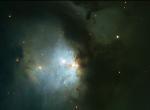
An eerie blue glow and ominous columns of dark dust highlight M78, a bright reflection nebula in the constellation of Orion. The dust not only absorbs light, but also reflects the light of several bright blue stars that formed recently in the nebula.
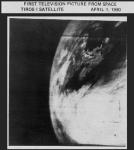 Planet Earth From TIROS 1: First TV Image
1.04.2000
The Television InfraRed Observational Satellite (TIROS) 1 was the first weather satellite. Launched into a polar orbit 40 years ago (April 1, 1960) equipped with two TV cameras, TIROS 1 was operational for only 78 days but demonstrated the feasibility of monitoring planet Earth's cloud cover and weather patterns from space.
|
January February March April May June July August September October |
|||||||||||||||||||||||||||||||||||||||||||||||||