
|
You entered: Sun
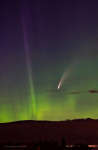 NEOWISE of the North
17.07.2020
After local midnight on July 14 comet NEOWISE was still above the horizon for Goldenrod, Alberta, Canada, just north of Calgary, planet Earth. In this snapshot it makes for an awesome night with dancing displays of the northern lights. The long-tailed comet and auroral displays are beautiful apparitions in the north these days.
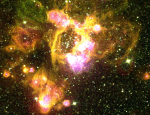 Superbubbles in the LMC
3.07.1996
Why is there a hole in the center of this nebula? A leading explanation is that it is caused by the stellar winds from the stars that live there. Stars - including the Sun - expel electrons, protons, and other charged ions in a steady stream - the stellar wind.
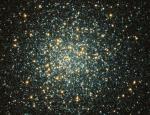 Globular Cluster M3
15.09.2003
This huge ball of stars predates our Sun. Long before humankind evolved, before dinosaurs roamed, and even before our Earth existed, ancient globs of stars condensed and orbited a young Milky Way Galaxy.
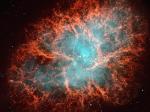 M1: The Crab Nebula from NOT
20.09.2005
This is the mess that is left when a star explodes. The Crab Nebula, the result of a supernova seen in 1054 AD, is filled with mysterious filaments. The filaments are not only tremendously...
 Lunation
8.11.1999
Our Moon's appearance changes nightly. This slow-loading time-lapse sequence shows what our Moon looks like during a lunation, a complete lunar cycle. As the Moon orbits the Earth, the half illuminated by the Sun first becomes increasingly visible, then decreasingly visible. The Moon always keeps the same face toward the Earth.
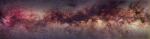 A Milky Way Band
30.09.2007
Most bright stars in our Milky Way Galaxy reside in a disk. Since our Sun also resides in this disk, these stars appear to us as a diffuse band that circles the sky.
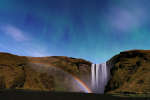 Waterfall, Moonbow, and Aurora from Iceland
14.11.2011
The longer you look at this image, the more you see. Perhaps your eye is first drawn to the picturesque waterfall called Skogarfoss visible on the image right. Just as prevalent, however, in this Icelandic visual extravaganza, is the colorful arc of light on the left.
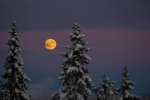 The Wolf s Moon
20.01.2012
A Full Moon rising can be a dramatic celestial sight, and Full Moons can have many names. Captured on January 8 from Ötersund, Sweden, this evocative moonrise portrait might make you feel the cold of winter in the north.
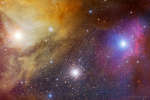 Antares and Clouds
17.04.2012
Antares is a huge star. In a class called red supergiant, Antares is about 850 times the diameter of our own Sun, 15 times more massive, and 10,000 times brighter. Antares is the brightest star in the constellation of Scorpius and one of the brighter stars in all the night sky.
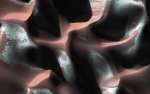 Martian Chiaroscuro
14.04.2018
Deep shadows create dramatic contrasts between light and dark in this high-resolution close-up of the martian surface. Recorded on January 24, 2014 by the HiRISE camera onboard the Mars Reconnaissance Orbiter, the scene spans about 1.5 kilometers.
|
January February March April May June July August September October |
|||||||||||||||||||||||||||||||||||||||||||||||||