
|
You entered: Sun
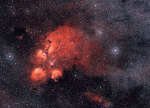 Wide Angle: The Cats Paw Nebula
21.04.2010
Nebulae are perhaps as famous for being identified with familiar shapes as perhaps cats are for getting into trouble. Still, no known cat could have created the vast Cat's Paw Nebula visible in Scorpius.
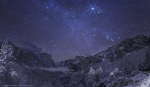 Yosemite Winter Night
25.12.2012
In this evocative night skyscape a starry band of the Milky Way climbs over Yosemite Valley, Sierra Nevada Range, planet Earth. Jupiter is the brightest celestial beacon on the wintry scene, though. Standing nearly opposite the Sun in the constellation Taurus, the wandering planet joins yellowish Aldebaran and the Hyades star cluster.
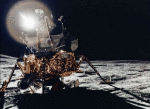 Apollo 14 on the Moon
9.12.1995
The jewel-like glare from a brilliant sun reflects off the lunar module of the Apollo 14 mission to the Moon as it rests on the lunar surface in February 1971. Astronauts Alan Shepard and Edgar Mitchell walked on the Moon's surface while astronaut Stuart Roosa piloted the orbiting command module.
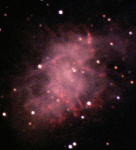 M1: The Crab Nebula
25.07.1995
In the year 1054 a star in the constellation of Taurus exploded in a spectacular supernova so bright it appeared to dominate the sky except for the Sun and Moon for many days. It left behind one of the most brilliant nebulae, listed first in Charles Messier's list of nebulous sky objects.
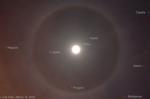 Stars and Planets in the Halo of the Moon
21.03.2003
Photographed on March 13th from Caledon, Ontario, Canada, a bright Moon was surrounded by this lovely halo. Planet Jupiter and stars Procyon, Castor, and Pollux also appear within the circle of lunar light. Castor...
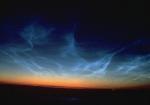 Noctilucent Clouds
19.06.2005
Sometimes it's night on the ground but day in the air. As the Earth rotates to eclipse the Sun, sunset rises up from the ground. Therefore, at sunset on the ground, sunlight still shines on clouds above.
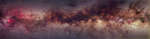 A Milky Way Band
10.07.2011
Most bright stars in our Milky Way Galaxy reside in a disk. Since our Sun also resides in this disk, these stars appear to us as a diffuse band that circles the sky.
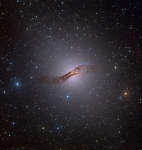 Centaurus A
17.03.2022
A mere 11 million light-years away, Centaurus A is the closest active galaxy to planet Earth. Spanning over 60,000 light-years, the peculiar elliptical galaxy also known as NGC 5128, is featured in this sharp telescopic view.
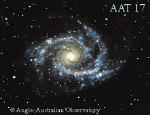 Grand Design Spiral Galaxy NGC 2997
30.10.1996
NGC 2997 is a grand design spiral galaxy. Its small nucleus and sprawling spiral arms give it a type "Sc" designation. NGC 2997 is speeding away from us at about 1100 kilometers...
 Mars Rover Races to Survive
12.12.2007
The Martian rover Spirit is now in the race of its life. The rolling robot is trying to reach an outpost to spend the winter, but it keeps getting bogged down in soft sand on Mars.
|
January February March April May June July August September October |
|||||||||||||||||||||||||||||||||||||||||||||||||