
|
You entered: space
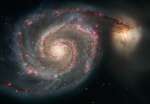 M51: Cosmic Whirlpool
5.01.2008
Follow the handle of the Big Dipper away from the dipper's bowl, until you get to the handle's last bright star. Then, just slide your telescope a little south and west and you might find this stunning pair of interacting galaxies, the 51st entry in Charles Messier's famous catalog.
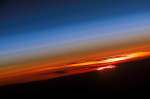 Sunset: Planet Earth
20.03.2008
Today, the Sun crosses the celestial equator heading north at 0548 UT. Known as the equinox, the geocentric astronomical event marks the first day of spring in the northern hemisphere and autumn in the south.
 Noctilucent Clouds Over Germany
24.06.2009
Sometimes it's night on the ground but day in the air. As the Earth rotates to eclipse the Sun, sunset rises up from the ground. Therefore, at sunset on the ground, sunlight still shines on clouds above.
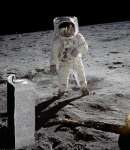 Evidence Mounts for Water on the Moon
1.04.2010
In 2009, space missions revealed tantalizing signs of water on or near the lunar surface, once thought of as a dry and desolate environment. But researchers are now offering this archival picture as further evidence that humans might one day be able to use the Moon's newly discovered resource to directly quench their thirst.
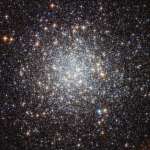 Messier 9 Close Up
23.03.2012
Renown 18th century astronomer Charles Messier described this 9th entry in his famous astronomical catalog as "Nebula, without star, in the right leg of Ophiuchus ...". But Messier 9 (M9) does have stars, known to modern astronomers as a globular cluster of over 300,000 stars within a diameter of about 90 light-years.
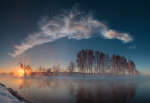 Miass River Sunrise
2.03.2013
Each day on planet Earth can have a serene beginning at sunrise as the sky gently grows bright over a golden eastern horizon. This sunrise panorama seems to show such a moment on the winter morning of February 15.
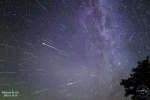 Perseid Meteors Over China
21.08.2013
Comet dust rained down on planet Earth earlier this month, streaking through dark skies in the annual Perseid meteor shower. While enjoying the anticipated space weather above Zhangbei Prairie, Hebei Province, China, astronomer Xiang...
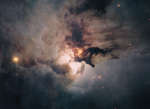 In the Center of the Lagoon Nebula
20.08.2014
The center of the Lagoon Nebula is a whirlwind of spectacular star formation. Visible near the image center, at least two long funnel-shaped clouds, each roughly half a light-year long, have been formed by extreme stellar winds and intense energetic starlight. The tremendously bright nearby star, Hershel 36, lights the area.
 NGC 4676: When Mice Collide
4.10.2021
These two mighty galaxies are pulling each other apart. Known as the "Mice" because they have such long tails, each spiral galaxy has likely already passed through the other. The long tails are created by the relative difference between gravitational pulls on the near and far parts of each galaxy.
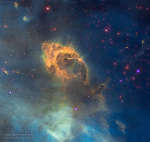 HH 666: Carina Dust Pillar with Jet
14.12.2021
To some, it may look like a beehive. In reality, the featured image from the Hubble Space Telescope captures a cosmic pillar of dust, over two-light years long, inside of which is Herbig-Haro 666 -- a young star emitting powerful jets.
|
January February March April May June July August September October |
|||||||||||||||||||||||||||||||||||||||||||||||||