
|
You entered: space
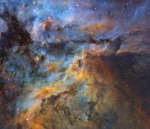 South of Carina
22.05.2020
With natal dust clouds in silhouette against glowing atomic gas, this colorful and chaotic vista lies within one of the largest star forming regions in the Milky Way galaxy, the Great Carina Nebula.
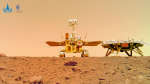 Zhurong: New Rover on Mars
15.06.2021
There's a new rover on Mars. In mid-May, China's Tianwen-1 mission delivered the Zhurong rover onto the red planet. As Mars means Planet of Fire in Chinese, the Zhurong rover's name means, roughly, God of Fire in Chinese mythology.
 The Protostars within Lynds 483
13.03.2025
Two protostars are hidden in a single pixel near the center of a striking hourglass-shaped nebula in this near-infrared image from the James Webb Space Telescope. The actively forming star system lies in a dusty molecular cloud cataloged as Lynds 483, some 650 light-years distant toward the constellation Serpens Cauda.
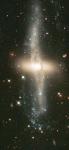 Polar Ring Galaxy NGC 4650A
10.05.1999
NGC 4650A appears to be two galaxies in one. A rare type of galaxy known as a Polar Ring, NGC 4650A is composed of an old central group of stars and a young ring of stars rotating farther out. Both components are clearly visible in this featured photograph by the Hubble Space Telescope.
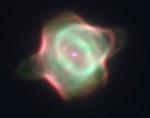 Hen 1357: New Born Nebula
6.10.2001
This Hubble Space Telescope snapshot shows Hen-1357, the youngest known planetary nebula. Graceful, gentle curves and symmetry suggest its popular name - The Stingray Nebula. Observations in the 1970s detected no nebular material, but this image from March 1996 clearly shows the Stingray's emerging bubbles and rings of shocked and ionized gas.
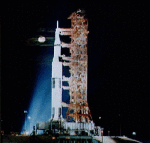 The Last Moon Shot
9.09.1995
In 1865 Jules Verne predicted the invention of a space capsule that could carry people. In his science fiction story "From the Earth to the Moon", he outlined his vision of constructing a cannon in Florida so powerful that it could shoot a "Projectile-Vehicle" carrying three adventurers to the Moon.
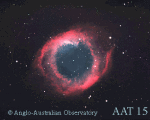 NGC 7293: The Helix Nebula
17.04.1996
The Helix nebula (New General Catalog number 7293) is estimated to be a mere 450 light-years from the Sun, in the direction of the constellation Aquarius. At that distance it may well be the closest planetary nebula, offering a dramatic snapshot of a brief final evolutionary stage in the life of a solar-type star.
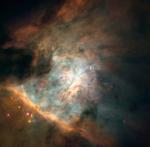 M42: A Mosaic of Orion's Great Nebula
22.05.1999
The Great Nebula in Orion, an immense, nearby starbirth region, is probably the most famous of all astronomical nebulae. Here, 15 pictures from the Hubble Space Telescope have been mosaicked to cover the inner 2.5 light years of the nebula and illustrate its diverse nature.
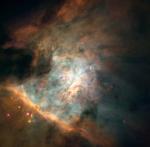 M42: A Mosaic of Orion's Great Nebula
11.05.1997
The Great Nebula in Orion, an immense, nearby starbirth region, is probably the most famous of all astronomical nebulae. Here, 15 pictures from the Hubble Space Telescope have been mosaicked to cover the inner 2.5 light years of the nebula and illustrate its diverse nature.
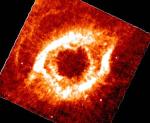 Infrared Helix
1.09.1997
Five hundred light years from Earth, in the constellation Aquarius, a sun-like star is dying. Its last few thousand years have produced the Helix, a well studied and nearby example of a Planetary Nebula - typical of this final phase of stellar evolution.
|
January February March April May June July August September October |
|||||||||||||||||||||||||||||||||||||||||||||||||